Your solar panels might get the attention, but the inverter is the part that decides how well the whole system performs day after day. If you are working out how to choose solar inverter products for an Australian home, business or industrial site, the right answer is rarely the cheapest unit on the quote. It is the inverter that suits your load profile, site conditions, future plans and reliability expectations.
A good inverter converts the direct current generated by your panels into usable alternating current for your property. A better one does that efficiently, handles Australian conditions, works well with your panels and battery strategy, and gives you confidence that support will still be there years from now. That is where many buying decisions are won or lost.
How to choose solar inverter for your site
The first step is not choosing a brand. It is understanding what the system needs to do. A household trying to trim evening power bills has different priorities from a warehouse aiming to reduce daytime demand charges, and both are different again from a regional facility where uptime matters more than squeezing out the last dollar of upfront savings.
Start with your energy use. Look at when you consume electricity, not just how much. If most of your demand happens during the day, a straightforward grid-connected inverter may do the job well. If you want stronger energy independence, blackout backup or a battery later, a hybrid inverter may be the smarter path even if it costs more upfront.
Roof layout matters as well. A simple north-facing roof with minimal shade gives you more flexibility. Multiple roof faces, partial shading, or a mix of panel orientations can make inverter selection more nuanced. In those cases, system design has a direct impact on yield, and the wrong inverter setup can leave performance on the table.
The main inverter types and where they fit
For most buyers, the practical choice comes down to string inverters, hybrid inverters and microinverters.
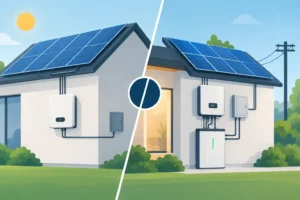
A string inverter is the most common option for residential and commercial systems. It is cost-effective, proven and well suited to sites where panels receive similar sunlight throughout the day. If the array design is clean and shading is limited, a quality string inverter often delivers strong value.
A hybrid inverter combines solar inversion with battery compatibility. This can be a strong option if you plan to add storage now or later. It may cost more than a standard string inverter, but it can reduce the need for major system changes down the track. For many Australian households dealing with rising tariffs and looking at battery readiness, that flexibility matters.
Microinverters sit on individual panels rather than using one central inverter. They are often worth considering when the roof is complex or shade affects panels unevenly. The trade-off is usually higher upfront cost, but they can improve performance and visibility at panel level on the right site.
There is no universally best type. There is only the best fit for your roof, budget and energy goals.
Sizing matters more than most people realise
An inverter should be matched properly to the solar array and the property load profile. Oversizing or undersizing is not always wrong, but it needs to be intentional.
Some solar systems are designed with a panel capacity that exceeds the inverter rating. This is common and can be sensible in Australia, where panel output varies through the day and year. Done properly, it can improve generation across the shoulders of the day. Done poorly, it can lead to unnecessary clipping and lost production during peak conditions.
For commercial and industrial projects, sizing becomes even more site-specific. Demand patterns, export limits, operating hours and future expansion all influence the right configuration. An inverter that looks fine on paper can become a bottleneck if the business adds equipment, extends shifts or adopts EV charging later.
Battery compatibility is worth thinking about early
Even if you are not installing a battery today, it is sensible to ask whether your inverter choice leaves the door open. Battery uptake in Australia continues to grow because many customers want more control over evening usage, tariff exposure and backup options.
This does not mean every system needs a hybrid inverter. In some cases, a battery-ready design can be achieved in other ways. But if storage is likely within the next few years, planning for it now can save money and complexity later. The cheapest inverter on day one is not always the lowest-cost decision over the life of the system.
How to compare solar inverter quality
When people compare inverters, they often focus on efficiency percentages. Efficiency matters, but it is only one part of the decision.
A better comparison looks at warranty length, service support, monitoring platform, operating temperature range, weather protection and compatibility with the rest of the system. Australian conditions can be harsh, especially on exposed commercial and industrial sites. Heat, dust and installation environment affect how an inverter performs over time.
It is also worth looking at the supplier and installer behind the product. If there is a fault in five years, the real question is not just what the warranty says. It is how practical and responsive the support process will be. This is one reason many buyers prefer working with a provider that can design, install and maintain the full system rather than stepping away after commissioning.
Monitoring and visibility are not just nice extras
A solid monitoring platform helps you confirm the system is performing as expected. For homeowners, that means seeing generation, usage and potentially battery behaviour in a straightforward app. For businesses, it can mean identifying faults quickly, tracking savings and spotting performance drift before it becomes expensive.
The level of detail you need depends on the site. A small residential system may only need clear daily reporting and alerts. A commercial site may need more advanced visibility, especially if energy management forms part of broader operational planning.
Common mistakes when choosing an inverter
One of the most common mistakes is buying to a headline price. A low-cost inverter can be acceptable if the product is fit for purpose and support is credible. But if price is the only reason it made the shortlist, it is usually the wrong starting point.
Another mistake is choosing for today only. If your energy use is likely to change because of an electric vehicle, battery, equipment upgrade or business growth, the inverter should be assessed in that context.
The third is ignoring site complexity. Shading, orientation, export constraints and switchboard conditions all influence inverter choice. A standard recommendation may not be the right one for your property.
Questions worth asking before you sign
If you want confidence in your decision, ask how the inverter was matched to your usage, roof layout and future plans. Ask whether the design allows for battery integration later. Ask what monitoring is included, who handles warranty support, and what happens if the inverter fails.
For commercial and industrial buyers, add questions about demand reduction strategy, export limitations, SCADA or energy management integration if relevant, and how maintenance will be handled over the system life.
The quality of the answers matters as much as the specifications. If the explanation is vague, the design probably is too.
Choosing the right solar inverter is really about fit
The best inverter is not the one with the longest brochure or the most features you will never use. It is the one that fits your site, matches your goals and gives you confidence that the system will keep delivering value over time.
For some properties, that means a dependable string inverter with strong support behind it. For others, it means a hybrid setup ready for battery storage, or panel-level optimisation to deal with roof complexity. The smart decision comes from looking at performance, flexibility and aftercare together rather than treating the inverter as a box to tick on a quote.
If you are weighing up options, take the time to look past the sticker price. A well-chosen inverter can improve savings, reduce future upgrade costs and make the whole solar investment work harder for years to come. That is usually where the real value sits.