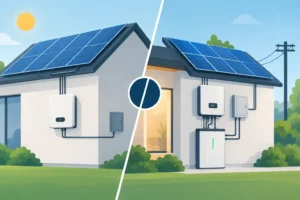
A home battery can turn surplus daytime solar into power for the evening peak, when many Australian households pay their highest electricity rates. That makes battery incentives Australia 2026 a practical consideration, not just a headline. The available support can reduce upfront cost, but the value you receive depends on battery size, location, installation date, energy use and whether the system meets scheme requirements.
For businesses, the calculation is broader. A correctly designed battery may reduce demand charges, manage volatile grid costs and improve the value of onsite solar. Incentives can help, but the strongest case usually starts with the site’s load profile and operational needs.
The main federal battery incentive in 2026
The key national support mechanism is the federal Cheaper Home Batteries Program, administered through the Small-scale Renewable Energy Scheme. Eligible battery installations can create small-scale technology certificates, commonly called STCs. Those certificates are generally assigned to the installer or retailer as part of the transaction, with their value passed on as an upfront discount in the quoted price.
This is not a cash payment that arrives after installation. In most cases, it is a point-of-sale discount, making it easier to see the out-of-pocket cost before you proceed.
The federal incentive is designed for eligible small-scale battery systems installed with a new or existing solar PV system. It is available for homes, small businesses and community facilities that meet the program rules. Battery capacity, approved equipment, installer accreditation and correctly completed paperwork all matter.
The incentive rate reduces over time. Certificate creation rates are scheduled to decline annually, and certificate market prices can also move. For that reason, an estimate from last year should not be used to judge a 2026 quote. A current proposal should show the battery’s eligible capacity, the assumed certificate value and the discount applied.
What battery sizes may qualify?
Under the federal program, eligibility is generally aimed at batteries with a nominal capacity from 5 kWh to 100 kWh. Only a defined portion of capacity may be eligible for certificates, so the incentive should not be calculated simply by multiplying the full battery size by a headline dollar figure.
A battery should be sized around your actual solar generation and evening consumption, rather than the largest incentive available. A system that is too small may not cover the high-cost period. One that is too large may spend long periods underused, particularly if the household is away during the day or has limited solar production in winter.
A tailored assessment looks at interval data, roof generation, controlled loads, heating and cooling, pool pumps, EV charging and plans to electrify appliances. That is the better starting point for battery value.
Equipment and installation requirements
Battery incentives are not available for every product or every installation approach. The battery and inverter must satisfy the applicable standards and program eligibility requirements, and the system needs to be installed by appropriately accredited professionals.
The battery must also be installed safely and in a suitable location. This can affect whether it is mounted in a garage, on an external wall or in another compliant position. Switchboard upgrades, metering work, backup circuits and site access can influence the final project cost, even where the battery itself qualifies for an incentive.
State battery incentives in Australia for 2026
State and territory programs can sit alongside federal support, but they vary significantly. Some jurisdictions offer rebates, others focus on low-interest loans, virtual power plant incentives or energy-efficiency programs. Several earlier schemes have closed, changed or been fully allocated, while new offers may be limited by budget or postcode.
This is why a national headline cannot tell you exactly what is available at your address. Your retailer, distribution network and state rules all affect the outcome.
For example, a state program may require the battery to be installed by an approved provider, meet a minimum battery capacity or be connected to a participating virtual power plant. Another may support particular customer groups, such as eligible concession households. In some areas, the practical opportunity may be a retailer tariff or demand-response offer rather than a direct rebate.
Before relying on any state-based saving, confirm four details in writing:
- whether the program is open when your installation is booked
- whether your postcode and property type are eligible
- whether the proposed battery and installer are approved
- whether joining a virtual power plant or finance arrangement is required
A good quote separates confirmed incentives from estimates. It should also make clear whether an offer can be combined with federal STCs. Not all programs can be stacked, and claiming an incentive that does not apply can create delays or unexpected costs.
How to assess the value beyond the rebate
An incentive improves the purchase price, but it should not be the only reason to install a battery. The system needs to work for your electricity plan and the way your property uses energy.
For a household, the biggest benefit often comes from charging the battery from excess solar and discharging it through the evening. The outcome depends on solar output, battery usable capacity, round-trip efficiency, export limits and the gap between your solar feed-in tariff and the price you pay to import electricity.
If your feed-in tariff is low and your evening usage is high, storing solar can be particularly attractive. If you already export very little because you use most of your solar during the day, a battery may still help, but the financial case can be different. Backup power may also be valuable, especially in areas with unreliable supply, but not every battery provides whole-home backup as standard.
For commercial sites, battery design should account for more than energy arbitrage. Demand charges, peak intervals, operating hours, refrigeration, process loads and solar generation all influence the result. A battery that reduces a short, expensive afternoon peak can have a different commercial value from one designed mainly to maximise solar self-consumption.
Larger commercial and industrial projects may fall outside small-scale certificate rules. They may instead require a feasibility assessment that considers large-scale certificate arrangements, power purchase agreements, network constraints and the site’s broader decarbonisation plan. The right pathway depends on project scale and consumption profile.
Virtual power plants: incentive or trade-off?
Some battery offers are linked to virtual power plants, often called VPPs. A VPP connects many batteries so they can respond collectively to grid events. In return, the customer may receive an upfront incentive, ongoing credits or access to a specific electricity plan.
This can make sense where the terms are clear and the benefit is worthwhile. However, VPP participation is not identical across providers. Check how often the battery may be called on, whether a minimum stored-energy reserve can be maintained, how export and import rates work, and whether there are exit fees or contract periods.
For customers who place a high value on outage protection, reserve settings deserve particular attention. A VPP arrangement should not leave you with less backup power than you expected during a local outage.
Questions to ask before accepting a 2026 battery quote
A transparent proposal should show the system before and after incentives, rather than presenting one bundled number. It should identify nominal and usable battery capacity, estimated annual savings, assumptions about electricity tariffs and any allowance for future tariff changes.
Ask whether the quote includes monitoring, commissioning, warranty support and assistance with incentive documentation. Also ask about the inverter’s backup capability, the number of backed-up circuits, switchboard work and ongoing service options. These details affect both performance and the installed price.
Be cautious of savings claims that assume every kilowatt-hour of stored energy avoids the highest grid rate. Real savings depend on when the battery charges and discharges. A credible design uses your consumption data where available and explains the assumptions used where it is not.
Make the incentive work for your energy plan
The best battery incentive is one attached to a system that continues to perform after the discount has been applied. For residential customers, that means matching battery capacity, solar production and household demand. For commercial and industrial customers, it means designing around operational peaks, tariff exposure and future electrification.
SAE Group can assess the practical value of a battery alongside solar, EV charging, backup requirements and available financing, then provide a clear view of applicable incentives before installation. A current, site-specific assessment is the most reliable way to turn a 2026 incentive into lower energy costs over the years ahead.