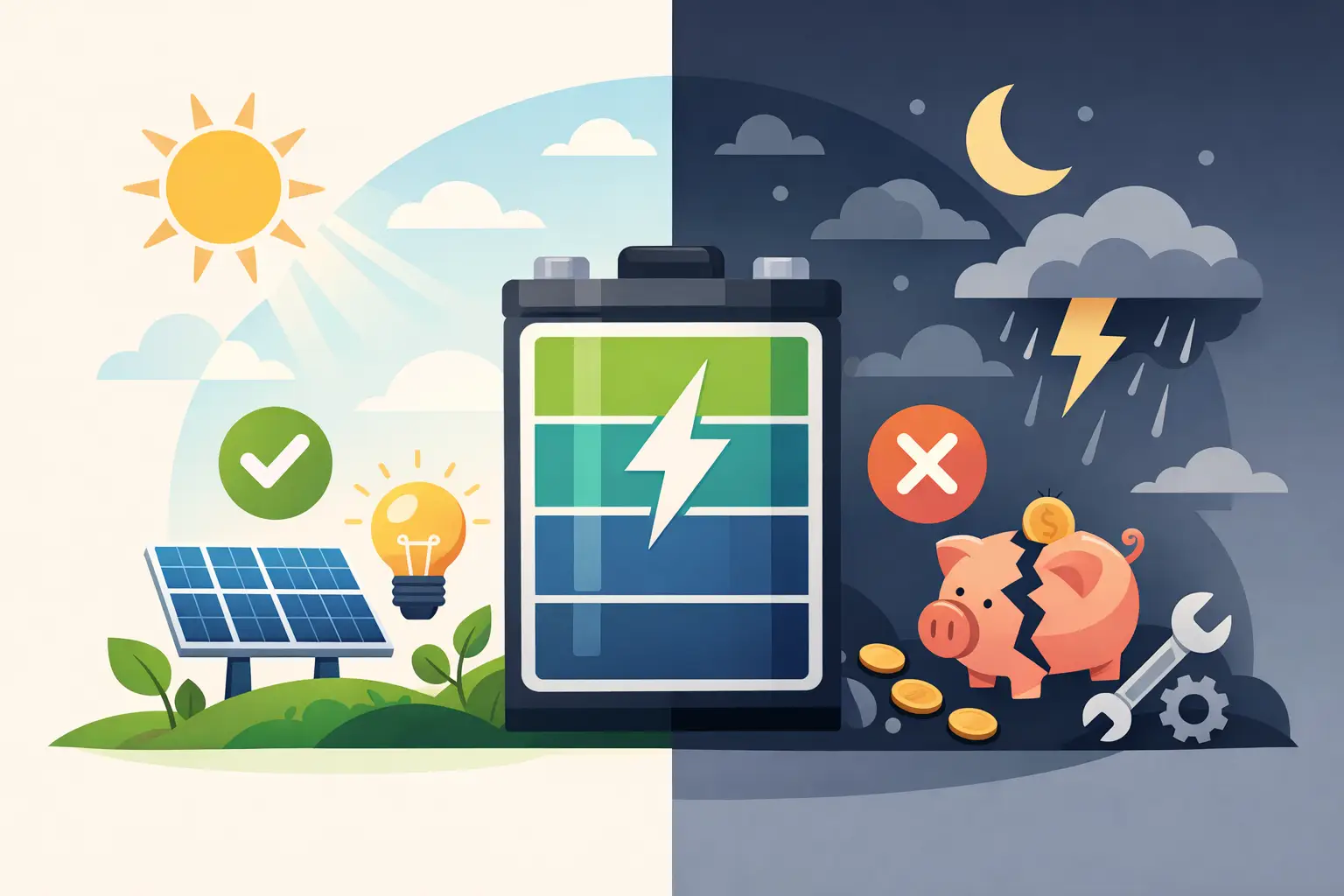
A solar system that exports cheap excess power in the middle of the day, then buys expensive grid electricity back after sunset, can feel like a missed opportunity. That is exactly why the pros and cons of solar battery storage matter so much for Australian households and businesses. A battery can shift when your solar energy is used, but whether it is the right investment depends on your usage patterns, tariff structure, site setup and long-term goals.
For some customers, battery storage is the missing piece that turns a good solar system into a stronger energy-saving asset. For others, it adds cost without delivering the return they expect. The right decision comes from matching the technology to the way you actually consume power, not simply following the latest trend.
What solar battery storage actually does
At its simplest, a solar battery stores surplus electricity generated by your solar panels so it can be used later. Instead of sending all excess daytime generation to the grid, the battery keeps some of that energy on site for use in the evening, overnight or during periods of high electricity prices.
This changes the economics of a solar system. In many parts of Australia, feed-in tariffs are modest compared with the cost of buying electricity from the grid. If you can store your own solar energy and use it later, each kilowatt-hour may be worth more to you than exporting it.
Battery storage can also support backup power, demand management and greater energy independence, depending on the system design. That matters for homeowners wanting more control over bills, and for commercial or industrial sites where energy reliability and cost predictability can affect operations.
The main pros and cons of solar battery storage
Pro: Lower reliance on the grid
The most obvious benefit is using more of the solar energy you generate. Without a battery, a lot of solar production may occur when no one is home or when business demand is low. With storage, that excess generation can be shifted to the times when electricity is more expensive or more valuable to your site.
For households, that often means covering evening loads such as lighting, cooking, heating or cooling. For businesses, it may mean reducing grid purchases during shoulder or peak pricing windows. The result can be lower electricity bills and less exposure to retail price rises.
Pro: Better value from your solar system
A battery can improve self-consumption, which is often where the strongest financial value sits. This is especially relevant in Australia, where retail import rates are usually much higher than feed-in tariff rates. If your exported solar earns relatively little, storing and using that energy later can make the solar system work harder for you.
This is one reason battery adoption is growing in both residential and commercial settings. It is not only about producing clean energy. It is about using that energy at the right time.
Pro: Backup power in outages
For many buyers, backup capability is a major drawcard. A properly configured battery system can keep essential circuits running during a blackout. That may include refrigeration, lights, communications, security systems or key equipment.
That said, not every battery setup automatically provides backup. The system needs to be designed for it, and there may be limits on which loads can be supported and for how long. This is where tailored system design matters. Backup expectations need to match battery capacity, inverter capability and your actual energy use during outages.
Pro: More control over energy costs
Battery storage can give homes and businesses more flexibility in how and when they use electricity. In some cases, batteries can be programmed to charge from solar, discharge during expensive tariff periods, or help reduce demand spikes.
For commercial and industrial customers, this can be particularly useful where tariffs include demand charges or time-of-use pricing. A battery may not eliminate these costs entirely, but it can be part of a broader strategy to smooth consumption and improve site efficiency.
Con: Higher upfront cost
The clearest drawback is the initial investment. Batteries add materially to the cost of a solar project, and the payback period is usually longer than solar panels alone. That does not mean the investment is poor, but it does mean the economics need to be assessed carefully.
For some customers, the numbers make sense because they place high value on backup power, energy independence or future bill protection. For others, especially where evening usage is low or electricity tariffs are less punitive, the return may be slower than expected.
Con: Payback depends on your usage
Battery performance on paper is only part of the picture. Real value depends on how much excess solar you generate, when you use electricity, your tariff structure and whether the battery is correctly sized.
A household with strong daytime consumption may already use much of its solar directly, leaving less surplus to store. A business that closes before peak evening periods may also see different value than one operating later into the day. This is why a one-size-fits-all battery recommendation rarely works.
Con: Battery lifespan and degradation
Like most energy technologies, batteries do not perform at the same level forever. Over time, usable capacity typically declines. Warranties help define expected performance, but battery longevity still needs to be factored into the financial case.
This is not necessarily a deal-breaker. It simply means buyers should look beyond upfront price and compare quality, warranty terms, performance expectations and after-sales support. A cheaper battery with weaker support may not represent better value over the long term.
Con: Not every site needs one yet
There is a tendency to assume that if solar is good, adding a battery must always be better. In reality, some sites are better suited to battery storage than others. If your solar exports are limited, your evening demand is modest, or your tariff setup does not reward load shifting, battery storage may not be the first upgrade to prioritise.
In those cases, improving solar system sizing, inverter performance, load scheduling or overall site efficiency may deliver stronger short-term returns.
When solar battery storage makes the most sense
Homes with high evening energy use
If your household uses a meaningful share of electricity after sunset, battery storage may be a practical fit. Families running air conditioning in the evening, cooking on electric appliances, charging an EV overnight or simply consuming most of their power outside solar production hours often have a stronger case for storage.
It can also appeal to regional homeowners or anyone concerned about grid reliability, provided backup capability is built into the design.
Businesses seeking cost stability
Commercial sites with time-of-use tariffs, long operating hours or a desire to reduce exposure to rising electricity prices may benefit from battery integration. Offices, retail, hospitality, agriculture and light industrial facilities can all present good use cases, but the details matter.
Battery storage is often most effective when it is planned as part of a complete energy strategy rather than added in isolation. Solar generation profile, site load, operating hours and future expansion plans all influence the result.
Sites planning for electrification
If you expect your electricity demand to grow, storage may become more attractive over time. That could be due to EV charging, all-electric appliances, expanded operations or a shift away from gas. In that context, a battery can support a broader move towards cleaner and more controlled energy use.
How to weigh the decision properly
The strongest buying decisions come from modelling, not guesswork. The question is not whether batteries are good in general. The question is whether they are good for your property, your tariff and your goals.
That means looking at your load profile, not just your total bill. It means checking how much solar surplus you actually have, when you need power most, what backup loads are essential, and whether incentives or financing improve affordability. It also means comparing product quality, inverter compatibility, warranty support and ongoing service.
This is where working with an experienced provider can make a real difference. A tailored recommendation should tell you when battery storage stacks up, and just as importantly, when it may be better to wait.
A realistic view of the pros and cons of solar battery storage
The best thing about battery storage is that it gives you more control. The hardest thing about battery storage is that the value is highly case-specific. It can reduce grid reliance, improve bill savings, support backup power and help future-proof your energy setup. It can also involve a significant upfront cost and a payback period that varies widely from site to site.
For Australian customers, the smart approach is to treat storage as a strategic investment rather than an automatic add-on. When the system is properly designed around your usage, it can deliver practical long-term value. When it is chosen on assumptions alone, it can disappoint.
If you are considering battery storage, the most useful next step is not chasing a generic answer. It is getting clear advice based on how your home, business or facility actually uses energy, because that is where the real value is found.