Power prices rarely wait for a convenient time to rise. For households, that usually shows up as bigger quarterly bills. For businesses and industrial sites, it can mean tighter margins, harder budgeting and more pressure on operations. That is why solar battery storage solutions are moving from a nice extra to a serious energy strategy for Australian properties that want more control over when and how power is used.
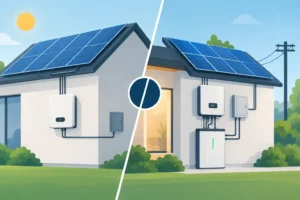
A battery does more than store spare solar generation from the middle of the day. It changes the way a site interacts with the grid. Instead of exporting excess solar for a modest feed-in tariff and buying electricity back later at a much higher rate, a battery can hold that energy for evening use, overnight loads or high-tariff periods. Done properly, that shift can improve return on investment, increase energy independence and reduce exposure to price volatility.
What solar battery storage solutions actually do
At a practical level, solar battery storage solutions capture unused solar energy and make it available when your panels are not producing enough power. That might be after sunset at home, during early morning operations at a warehouse, or across peak demand windows for a commercial facility.
The value lies in timing. Solar panels often generate their best output during the middle of the day, when many residential properties are empty and some businesses are not using their full electrical load. Without storage, that surplus goes back to the grid. With storage, it can be used later when grid electricity is more expensive.
For some sites, battery storage also adds backup capability. That can be useful where outages are disruptive, but it is worth being precise here. Not every battery system provides full-home or full-site backup. Some only support essential circuits, and some grid-connected systems may not operate during a blackout unless they are specifically configured to do so. The design matters as much as the battery itself.
Why more Australians are looking at battery storage now
The case for batteries is stronger than it was a few years ago because the energy market has changed. Retail tariffs have increased, feed-in tariffs have generally softened, and more property owners now understand that self-consumption often matters more than exports.
For homeowners, the appeal is usually straightforward – lower evening power bills, better use of rooftop solar and more confidence around rising electricity costs. For commercial and industrial operators, the conversation is broader. Batteries can help reduce peak demand, smooth load profiles, support sustainability targets and improve the economics of existing solar systems.
There is also a planning advantage. Businesses with variable operating hours, refrigeration loads, machinery, EV charging demand or multiple tariff periods often benefit from a more tailored system design. In those cases, the best result does not come from choosing the biggest battery on the market. It comes from matching storage capacity, inverter performance and control settings to actual usage patterns.
Choosing the right solar battery storage solutions
The right system depends on what problem you are trying to solve. That sounds simple, but it is where many buying decisions go off track.
If your main goal is to reduce household evening consumption from the grid, a modest battery paired with a well-sized solar system may be enough. If your goal is blackout protection, the conversation shifts to backup loads, switchboard configuration and whether you want whole-home or partial backup. If you run a business with large afternoon and evening loads, demand management and tariff optimisation may matter more than backup.
Battery size is only one part of the decision. Usable capacity, discharge rate, cycle life, warranty terms, inverter compatibility and monitoring all affect real-world performance. A battery with strong headline capacity can still disappoint if it cannot deliver enough output for the loads you need to support.
This is why tailored design is so important. Two properties with similar annual electricity bills can need very different systems. One may use most of its power at night. Another may have heavy daytime air conditioning demand. One business may benefit from a battery that discharges slowly over several hours. Another may need shorter bursts of higher power.
Homes, businesses and industrial sites need different answers
Residential battery storage is usually centred on bill reduction, energy independence and backup for key appliances. In many homes, the best financial outcome comes from increasing solar self-use rather than exporting excess generation. Households with work-from-home schedules, pool pumps, air conditioning and growing EV charging needs can often make better use of stored energy than they expect.
Commercial sites tend to focus on operating costs and tariff structure. Offices, retail centres, schools, strata buildings and hospitality venues all have different load shapes. A battery can improve solar utilisation, reduce exposure to expensive peak periods and support a more predictable energy strategy. Where multiple meters, tenancy arrangements or equipment schedules are involved, design becomes more complex and more valuable.
Industrial facilities usually require a more rigorous assessment. High loads, shift-based operations, machinery start-up demands and site-critical continuity all need to be considered. In these environments, battery storage may sit within a broader renewable energy plan that includes solar arrays, inverters, energy monitoring, maintenance support and in some cases financing or power purchase structures. The opportunity can be significant, but so can the consequences of getting the specification wrong.
The cost question – and why payback is never one-size-fits-all
Most buyers eventually ask the same question: is it worth it? The honest answer is that it depends on system cost, tariff structure, daily usage profile, export levels and whether the battery is solving a financial problem, an operational problem, or both.
For homes, simple payback may be influenced by evening consumption, local electricity rates and available incentives. For businesses, the analysis can include demand charges, operational resilience, tax treatment and long-term electricity procurement strategy. A battery that looks average on a simple household-style calculation may still make strong commercial sense if it reduces peak demand or protects revenue during interruptions.
In Australia, incentives can also affect the equation. Depending on the site and system type, customers may have access to solar-related benefits such as STCs, [Cheaper Home Batteries Program] (https://saegroup.com.au/blog/cheaper-home-batteries-program-everything-you-need-to-know/) and other applicable commercial mechanisms. These need to be assessed carefully because incentive eligibility, value and structure vary. Good advice here can materially change project economics.
What matters most is not chasing the lowest upfront price. A cheaper battery with weaker support, unclear warranty pathways or poor system integration can cost more over time. Long-term value comes from sound design, quality components and reliable aftercare.
Installation, integration and ongoing support matter
Battery performance is not just about the product in the brochure. Installation quality, inverter selection, switchboard suitability, monitoring setup and commissioning all shape the outcome.
For new solar projects, batteries can be designed into the system from the start. For existing solar systems, retrofitting may be possible, but compatibility needs to be confirmed. Some sites require additional electrical works, switchboard upgrades or inverter changes.
Support after installation is just as important. Monitoring helps identify whether the system is charging and discharging as expected. Maintenance and warranty support provide confidence that issues will be addressed quickly. This is especially important for businesses and industrial operators, where downtime, poor performance or unclear fault responsibility can become costly.
That end-to-end approach is where working with an experienced provider becomes valuable. SAE Group, for example, works across residential, commercial and industrial environments, which means the advice can be based on actual operating conditions rather than a standard package.
When battery storage may not be the right move yet
A balanced conversation should also say this plainly: not every property should install a battery today.
If your site has low evening use, limited solar generation or a tariff structure that does not reward load shifting, the financial case may be weaker right now. Some customers are better off first improving solar sizing, replacing inefficient equipment or reviewing energy usage patterns.
That is not a reason to dismiss battery storage. It is a reason to assess it properly. The best solution is the one that fits your usage, budget and long-term plans, not the one with the biggest marketing claim.
The strongest battery projects start with a clear view of how your property uses power and what outcome you want to achieve. If the goal is lower bills, better backup, improved energy independence or a more stable cost base for your business, the right system can make a meaningful difference. The next step is not guessing the battery size – it is getting advice that turns your energy profile into a solution that actually performs.