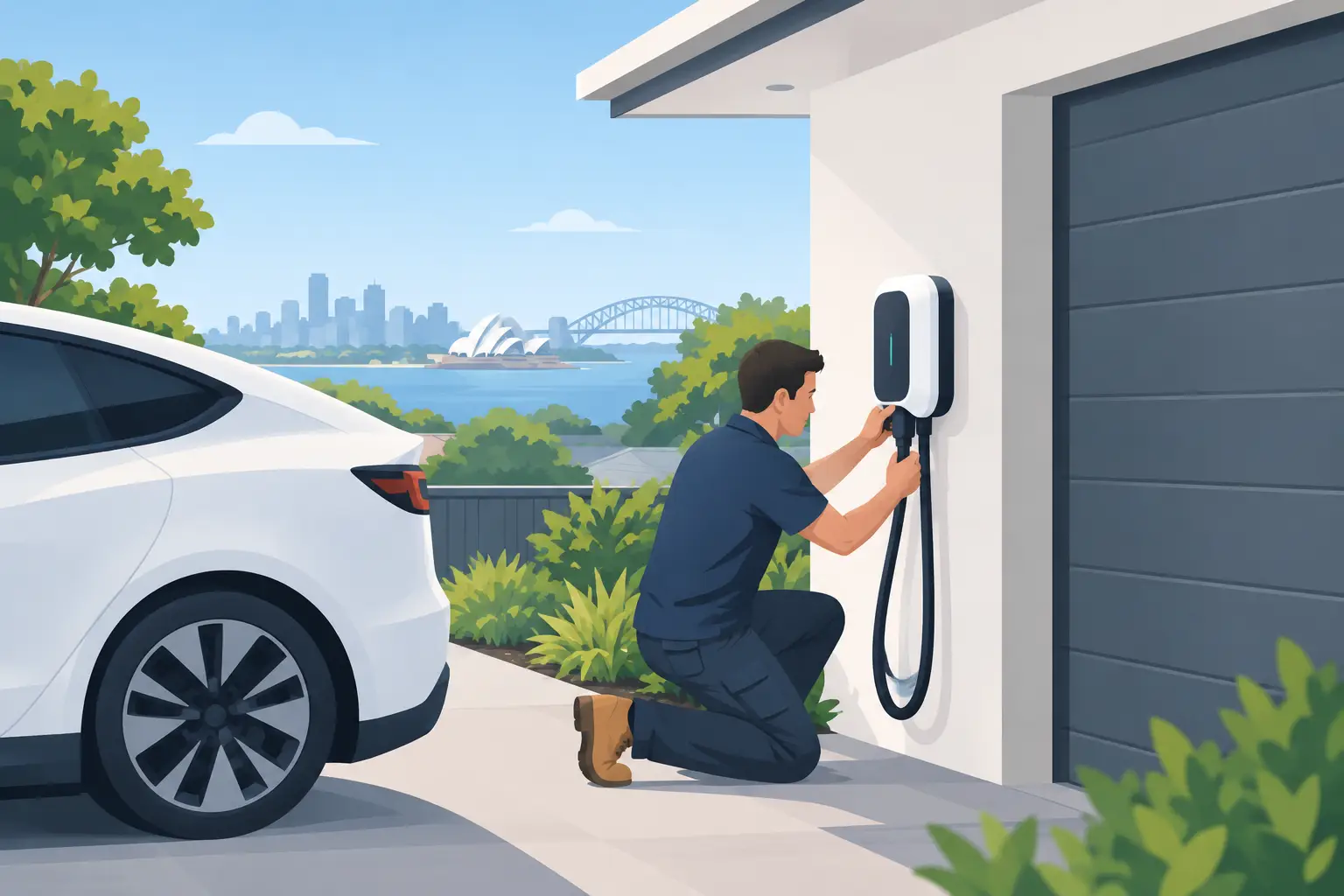
How to Install an EV Charger at Your Australian Home
Home » How to Install an EV Charger at Your Australian Home
An electric vehicle can be one of the largest electrical loads in a home, yet many owners still rely on a standard power point and slow overnight charging. When you install an EV charger designed for your property, you gain faster charging, stronger electrical protection and far more control over when your vehicle uses energy.
For Australian households, the best result is rarely about choosing the highest-powered unit on the shelf. It is about matching the charger to your vehicle, switchboard, electricity supply, driving habits and, where relevant, your solar and battery system. A properly designed installation can help you charge with lower-cost solar energy while avoiding unnecessary upgrades or demand issues.
Why install an EV charger at home?
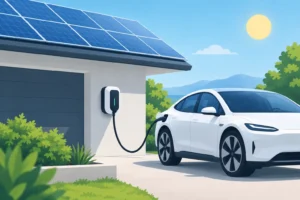
A dedicated wall-mounted charger, often called Level 2 charging equipment, is built for regular EV charging. It communicates with the vehicle, manages the charging load and is installed on a dedicated circuit by a licensed electrician.
The practical difference is significant. A portable charger connected to a standard socket may add limited driving range per hour and can take more than a full day to recharge a larger battery. A typical 7 kW single-phase home charger can add substantially more energy overnight, making it easier to begin each day with the range you need.
Home charging also gives you flexibility. You can schedule charging for off-peak electricity periods, set limits through a compatible app, or direct surplus solar generation into the vehicle. For many households, this reduces the need to visit public chargers except on longer trips.
There is a trade-off. Faster charging requires suitable electrical capacity and professional installation. The charger itself is only one part of the project. Your existing switchboard, cabling route, mains supply and solar configuration all affect what is practical and cost-effective.
Start with your vehicle and daily driving
Before selecting a charger, consider how much energy your vehicle needs between trips. A commuter travelling 40 to 60 kilometres per day may only need a few hours of charging overnight. A household with multiple EVs, a high-mileage sales vehicle or frequent regional travel may benefit from a higher-capacity solution and more advanced load management.
Most Australian homes have single-phase power. In this setting, a 7 kW charger is a common choice because it provides dependable overnight charging without requiring three-phase supply. Some properties have three-phase power and compatible vehicles, which may allow 11 kW or 22 kW charging. However, higher charging capacity is not automatically better. The vehicle’s onboard charger may limit the rate, and a faster unit can increase installation complexity or require switchboard and supply upgrades.
A qualified assessment should confirm the vehicle’s charging capability, the maximum power available at the property and whether other large appliances operate at similar times. Pool pumps, air-conditioning, electric hot water, induction cooking and batteries can all influence the right design.
Choose smart charging, not just fast charging
A smart EV charger can adjust charging in response to your household load, energy tariff or solar generation. This can be particularly valuable in homes with limited supply capacity, where charging at full power while several appliances are running could otherwise overload the main supply.
Solar-aware charging is another useful feature. Rather than exporting excess daytime solar energy to the grid at a lower feed-in tariff, a compatible charger can direct some or all of that generation to your EV. This works best for vehicles that are home during daylight hours, or for households able to schedule charging around solar production.
If your vehicle is usually away during the day, off-peak overnight charging may offer better value. The right approach depends on your tariff, export rate, solar output, driving routine and whether you have a home battery. A tailored calculation is more useful than assuming solar charging will always be the cheapest option.
What is involved to install an EV charger?
A professional installation begins with a site assessment. The installer checks the switchboard, main supply, earthing, available circuit capacity, location of the parking bay and the route needed to run cable safely to the charger.
The charger should be located where the cable can reach the vehicle charging port without creating a trip hazard across a driveway or footpath. It also needs protection from avoidable impact, water exposure and excessive heat. A garage wall is often straightforward, but carports, external walls and detached parking areas can be equally suitable when the equipment and cable route are selected correctly.
The electrician will install a dedicated circuit and the required electrical protection. Depending on the age and condition of the switchboard, additional work may be needed to create room for new protection devices or bring parts of the installation up to current requirements. Longer cable runs, trenching, masonry work and a separate distribution board can also affect the scope.
In some cases, the local electricity distributor may need to be involved, particularly if the installation requires a supply upgrade. Apartments, townhouses and strata properties add another layer of planning because common areas, shared electrical infrastructure and owners corporation approval may be relevant.
Load management can avoid costly upgrades
Load management monitors how much electricity the property is using and reduces or pauses EV charging when demand is high. Once demand falls, charging resumes automatically.
This is often a practical alternative to upgrading the mains supply. For example, if the oven, ducted air-conditioning and hot water system are operating during the evening peak, the charger can temporarily reduce its output rather than pushing the property beyond its available capacity. You still receive reliable overnight charging, but with a system designed around the way your home actually operates.
Integrating EV charging with solar and batteries
An EV is effectively a large, mobile electricity load. When integrated thoughtfully with solar, it can use energy that might otherwise be exported to the grid. For homeowners with a solar system, this can improve self-consumption and make better use of energy generated on the roof.
A solar-compatible charger may use a range of modes. It can charge only from surplus solar, blend solar with grid energy to maintain a selected charging rate, or follow a programmed schedule. Pure surplus-solar charging can be highly appealing, but it may be slower or interrupted by cloud cover. A blended approach is often more dependable when the vehicle needs to be ready by a certain time.
Home batteries can add another consideration. In some designs, charging the EV from a battery during the evening may not provide the best financial outcome, particularly if that battery capacity is needed to power the home after sunset. Settings should reflect your priorities: maximising solar use, reducing grid purchases, protecting backup power or ensuring the vehicle is charged for work.
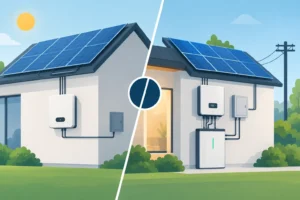
This is where an end-to-end energy assessment matters. The charger should work with your existing solar inverter, battery and monitoring platform where possible, rather than operating as an isolated appliance.
Selecting the right charger for your property
Charger choice should be based on quality, compatibility and service support as well as price. Look for a unit suited to Australian conditions, with appropriate weather protection for its location, a clear warranty and smart features you are likely to use.
Tethered chargers have a fixed cable, which is convenient for daily use. Socketed chargers allow you to use a separate cable and can offer flexibility if vehicle types change. Both can be suitable when installed correctly.
For households planning to change vehicles, add a second EV or expand solar capacity, it can be worthwhile to allow for future needs during the initial design. Installing suitable cable capacity or selecting a charger that supports load sharing may cost less than reworking the installation later.
Avoid treating a standard power point as a permanent charging solution unless it has been specifically assessed for that purpose. Regular, high-duration EV charging places a different demand on electrical equipment than occasional use of household appliances. Dedicated charging equipment provides a safer, more durable option.
EV charging for businesses and fleets
For commercial and industrial sites, EV charging requires a broader view of energy use. The key questions include when vehicles return to site, how long they are parked, which vehicles have priority, available switchboard capacity and how charging affects peak demand charges.
A workplace charger can support staff, customers, visitors or a fleet, but each use case needs different access controls and reporting. Fleet operations may require scheduled charging across multiple vehicles so every ute, van or passenger vehicle is ready for the next shift without creating an expensive demand spike.
Solar, batteries and charging controls can work together to reduce operating costs, although the best arrangement depends on site load profiles and tariff structure. A staged rollout is often sensible: assess the electrical infrastructure now, install chargers for immediate demand and preserve capacity for future expansion.
Get the design right before installation
The cost to install an EV charger varies because every property is different. A straightforward garage installation close to a modern switchboard is usually simpler than a long external cable run, a switchboard upgrade or a three-phase commercial installation. The cheapest quote may not include the load assessment, protection, commissioning or aftercare needed for reliable long-term performance.
SAE Group can assess your home or business energy use, charger requirements and solar integration options as part of a tailored renewable energy solution. The goal is not simply to fit a charger on the wall. It is to create a charging setup that supports your vehicle, protects your electrical system and helps you make smarter use of every kilowatt-hour.
A well-planned EV charger becomes part of how your property produces, stores and uses energy. Start with a professional assessment, and you can charge with confidence long after the first drive home.