String Inverter vs Hybrid Solar Systems Compared
Home » String Inverter vs Hybrid Solar Systems Compared
A solar quote can look simple until you reach the inverter line. The choice between a string inverter vs hybrid inverter affects what your system can do now, how easily it can add a battery later, and whether it can support selected circuits during a blackout. The right answer is not automatically the newest or most feature-packed option. It depends on your energy use, roof layout, future plans and budget.
For many Australian homes and businesses, a well-designed string inverter system is the most cost-effective way to reduce daytime electricity purchases. For others, particularly those planning battery storage or seeking greater energy resilience, a hybrid inverter can make stronger long-term sense. Understanding the difference helps you invest with confidence rather than paying for capability you may never use.
What is a string inverter?
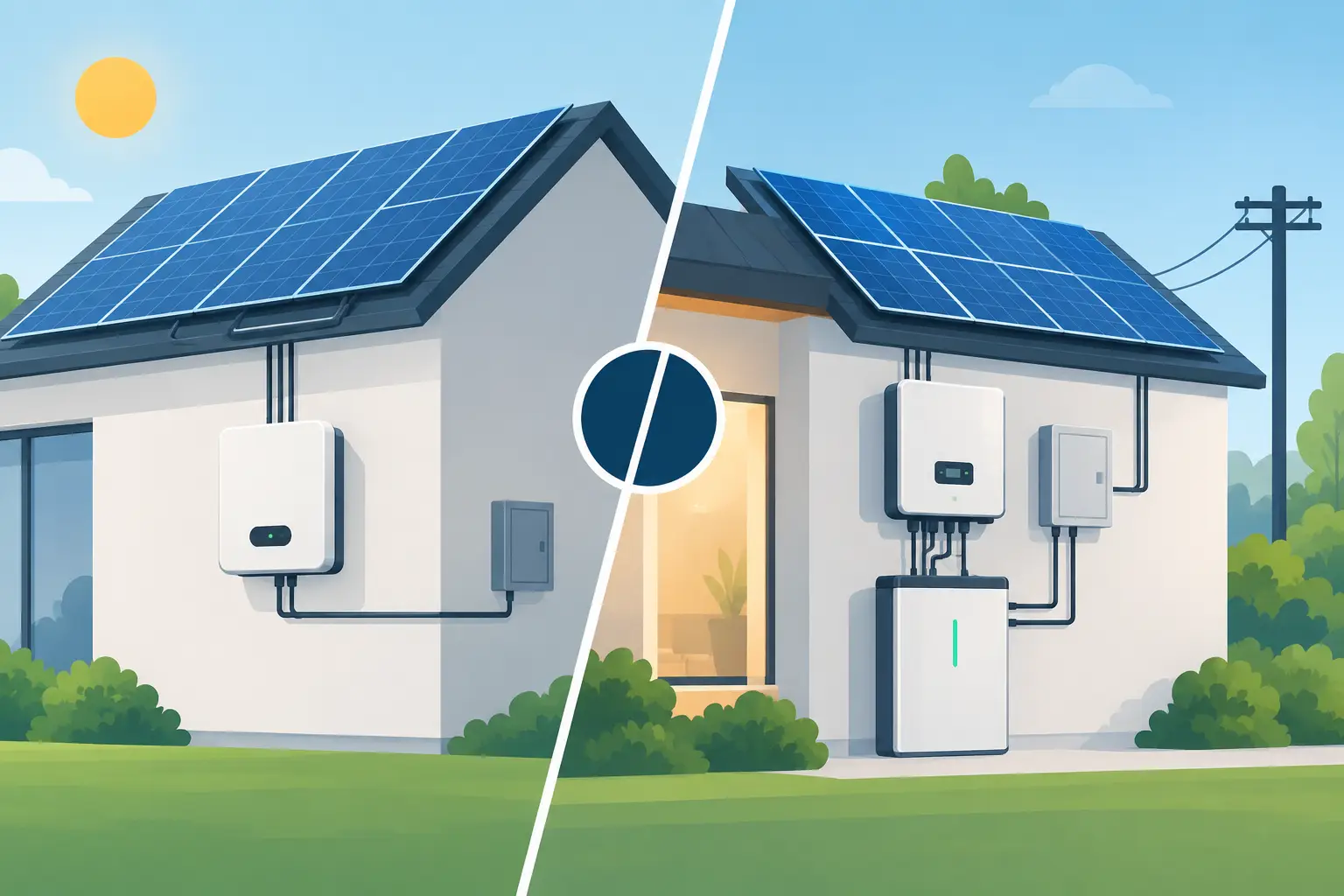
A string inverter is the conventional inverter used in many solar power systems. Solar panels are connected in groups, known as strings, and their direct current electricity is sent to a central inverter. The inverter converts it into alternating current electricity that can run appliances, power equipment and export surplus energy to the grid.
String inverters are proven, efficient and widely available. They suit straightforward rooftops where panels receive similar sunlight and the primary goal is to lower electricity bills through solar generation. A quality system can be designed with multiple maximum power point trackers, often called MPPTs, allowing separate panel groups to operate independently. This is useful where panels face different directions, such as north and west, or where one section has different levels of shading.
The key point is that a standard string inverter is generally focused on solar production. It does not directly manage a battery. If you decide to add storage later, you may need an AC-coupled battery system with its own battery inverter, or you may need to replace the existing inverter depending on the products selected and your desired backup capability.
What is a hybrid inverter?
A hybrid inverter combines solar conversion and battery management in one unit. It can convert solar energy for use in the property, charge a compatible battery from excess solar, and discharge stored energy when grid electricity is expensive or solar production is low.
This makes a hybrid inverter a practical option for customers who want a battery from day one or expect to add one in the near future. Rather than adding another major component later, the system is designed around solar and storage from the outset.
However, a hybrid inverter does not automatically mean full-home backup during a power outage. Backup performance depends on the battery capacity, inverter output, switchboard configuration and which circuits are connected to the backup supply. Some systems can support essential loads such as lighting, refrigeration, internet and selected power points. Others can be designed for broader backup, subject to the property’s electrical requirements and the system’s capacity.
String inverter vs hybrid: the practical differences
The most meaningful difference is not simply whether a battery can be added. It is how the system is designed to manage your energy.
A string inverter system sends solar power first to your home or business loads. Any excess is usually exported to the grid, earning a feed-in tariff where available. When solar production drops, you draw electricity from the grid. This is an effective model for sites that use plenty of power during daylight hours, such as homes with daytime occupancy, offices, workshops, retail premises and facilities with steady daytime loads.
A hybrid system can follow the same pattern, but it can store excess solar in a battery rather than exporting it. That stored energy can then be used in the evening, overnight or during high-tariff periods. For households with strong after-dark consumption, or businesses seeking to reduce peak demand and improve control over energy costs, storage can increase the value extracted from solar generation.
Hybrid systems also provide a clearer pathway to energy resilience. Yet the benefit needs to be assessed honestly. A battery is not a substitute for sensible load management. Running ducted air conditioning, electric cooking, pool pumps and multiple high-demand appliances during an outage can drain even a sizeable battery quickly. A tailored design identifies the loads that matter most and matches battery and backup capacity accordingly.
When a string inverter is the better choice
A string inverter is often the stronger financial choice when your focus is immediate solar savings and you have no firm plan to install a battery. It has a lower upfront cost than a comparable hybrid-and-battery-ready solution, leaving more of your budget available for high-quality panels, an appropriate system size and professional installation.
It can be particularly suitable when your electricity demand is concentrated during the day. For example, a business operating from 8 am to 5 pm may consume most of its solar generation as it is produced. In that case, exporting less energy to the grid is achieved through direct daytime use, not necessarily through battery storage.
A standard string inverter can also be a sensible option for a homeowner who wants solar now but prefers to wait for battery pricing, product options or household energy needs to develop. This approach is still compatible with a future battery in many cases, but it should be planned early. Your installer can assess whether AC-coupled storage would be appropriate and allow suitable switchboard space, cable pathways and metering arrangements.
When a hybrid inverter is worth considering
A hybrid inverter is usually best suited to customers who are committed to battery storage now, or who have a clear and near-term plan to install one. Designing the system as solar-plus-storage from the beginning can reduce later complexity and provide a more integrated way to manage generation, battery charging and household consumption.
It is also compelling where evening electricity use is consistently high. Families returning home after work, charging an EV overnight, cooking with electricity, heating or cooling living areas, and running appliances after sunset can all increase the value of stored solar energy. The outcome still depends on tariff structure, battery size, export rates and daily consumption patterns.
For commercial and industrial sites, hybrid systems may be considered where operational continuity, peak-period energy use or sustainability targets justify storage. The economics can be more complex than for a home. Load profiles, demand charges, operating hours, generator arrangements and future site expansion all need to be considered before selecting equipment.
Battery-ready does not always mean hybrid
This is where solar terminology can create confusion. Some string inverter systems can work with a battery later, but that does not make the inverter a hybrid model. An AC-coupled battery has its own inverter and connects on the alternating current side of the solar system. It can be an excellent retrofit solution, especially where a quality solar system is already installed.
A DC-coupled battery, by contrast, is typically managed through a compatible hybrid inverter. It can be efficient because solar energy can charge the battery before being converted to AC for use in the property. But neither arrangement is universally superior. Product compatibility, required backup features, available space and the existing electrical setup all influence the best approach.
The lesson is simple: do not choose an inverter based on the phrase “battery ready” alone. Ask what battery models are compatible, whether blackout backup is available, which circuits can be backed up, and what additional work would be needed if storage is installed later.
Cost, incentives and long-term value
A string inverter generally costs less upfront because it is a solar-only component. A hybrid inverter costs more, and the total investment rises further when a battery is included. That higher cost should be weighed against the value of using more of your own solar, reducing grid purchases at expensive times and gaining selected backup capability.
Solar panel installations may be eligible for Small-scale Technology Certificates, which can reduce the upfront cost of an eligible system. Battery incentives and rebates vary by state, territory and program, so they should be confirmed at the time of quoting. Feed-in tariffs also vary by retailer and location, and they are usually lower than the cost of buying electricity from the grid. This is one reason self-consumption has become central to solar system design.
Long-term value comes from choosing the right system size and equipment for your actual usage, not from selecting the lowest initial price. An undersized inverter can limit system performance. An oversized battery may take too long to pay for itself. Poor roof design or inadequate aftercare can reduce returns regardless of the equipment chosen.
Choosing the right inverter for your property
Before deciding, review your interval data or electricity bills to understand when you use power, not just how much you use. Consider your likely changes over the next five to 10 years: an EV, electric hot water, a growing family, new machinery, extended operating hours or a move away from gas can all change the ideal system design.
It is equally important to assess the roof and electrical site conditions. Shade, panel orientation, switchboard capacity, available wall space, internet connectivity for monitoring and local grid requirements can affect the equipment and configuration recommended. For businesses, a detailed load assessment is particularly valuable because a system that looks right on annual consumption alone may not suit the site’s peak demand profile.
SAE Group’s approach is to match solar, battery and inverter options to the property’s goals, rather than treating every site as a standard package. That includes considering installation quality, approved product compatibility and the support needed to keep the system performing over its working life.
A string inverter can be a smart, affordable solar-first decision. A hybrid inverter can be the better platform for storage, tariff control and selected backup. The most useful choice is the one that reflects how you use energy now and leaves room for the changes you can genuinely see ahead.