AC versus DC Batteries: What Solar Owners Need
Home » AC versus DC Batteries: What Solar Owners Need
A battery does not simply store the solar power from your roof and release it later. It must also manage the difference between the direct current produced by solar panels and the alternating current used by most Australian homes and businesses. That is why the choice between AC versus DC batteries can affect system efficiency, upfront cost, backup capability and how easily your system can grow over time.
The terminology can be confusing because the battery cells themselves store energy as DC. In practice, the comparison is usually between an AC-coupled battery system and a DC-coupled battery system. The right option depends on your existing equipment, when you use electricity, whether backup power matters, and the size and complexity of your energy needs.
AC versus DC batteries: the practical difference
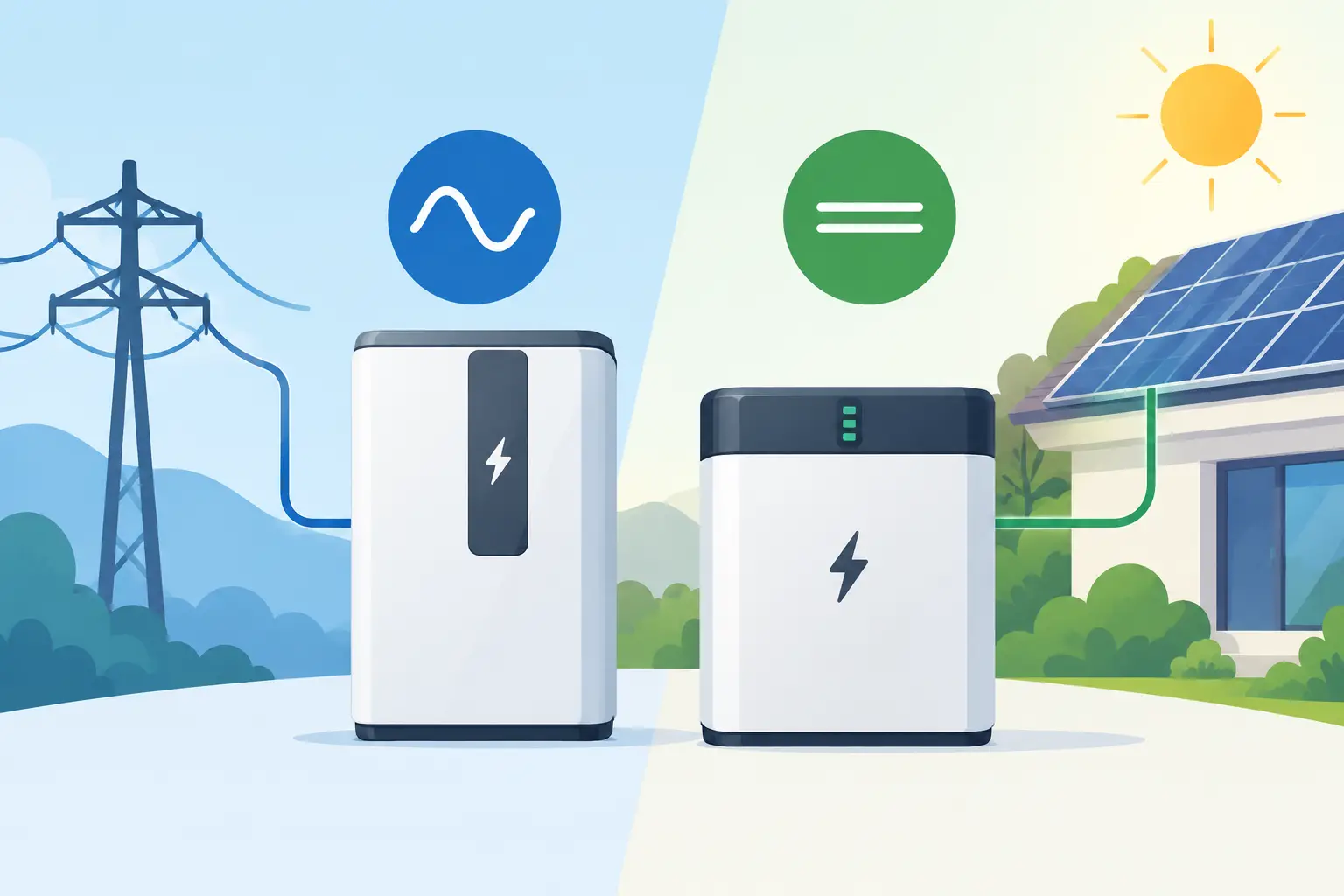
Solar panels generate DC electricity. Appliances, machinery and standard power points use AC electricity. An inverter converts DC from the panels into AC for use on-site or export to the grid.
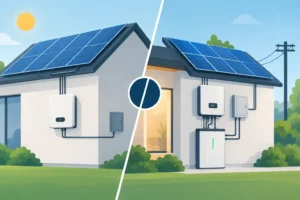
A DC-coupled battery connects on the DC side of the solar system, typically through a compatible hybrid inverter. Solar energy can be sent to the battery before it is converted to AC for your property. When the battery discharges, its energy is converted to AC for use in the building.
An AC-coupled battery has its own battery inverter and connects on the AC side of the system. Solar power is first converted from DC to AC by the solar inverter. To charge the battery, that AC power is converted back to DC. When stored energy is needed, it is converted to AC again.
Neither arrangement is automatically better. DC coupling can reduce conversion losses in a new, integrated solar and battery installation. AC coupling can be highly practical when adding storage to an existing solar system, particularly where replacing a working inverter would add unnecessary cost.
When a DC-coupled battery makes sense
DC-coupled systems are often well suited to new solar and battery projects. Because the solar array, battery and hybrid inverter are designed to work together, the system can be configured as a single energy platform from the outset.
The main advantage is efficiency. Sending solar generation directly into the battery involves fewer conversion steps than an AC-coupled arrangement. The difference is not usually dramatic enough to outweigh every other consideration, but it can become meaningful for households and businesses that regularly charge and discharge their battery.
A DC-coupled design can also provide a neat, space-efficient installation with fewer major components. For a homeowner building a new system, this may simplify the decision-making process and provide a clear pathway for future energy management features, such as EV charging or smart load control.
For commercial sites, DC coupling can be attractive where a new solar installation and battery are being designed around the site’s load profile. A tailored design can prioritise daytime solar use, reduce peak grid demand and retain more generated energy for later use.
There are trade-offs. A DC-coupled battery generally needs to be compatible with the hybrid inverter. If you want to expand capacity later, the available options may be tied to that equipment range and its technical limits. This is why sizing the inverter, solar array and battery together is so important.
Where AC-coupled batteries are strongest
AC-coupled batteries are commonly chosen for retrofits. If your home or business already has a sound solar system with a relatively new inverter, an AC-coupled battery can often be added without removing and replacing that equipment.
That flexibility is valuable. It lets you add storage to a solar system that is already performing well, while retaining the original panel and inverter setup. In some cases, it can also make staged upgrades easier. You may install a battery now and add further solar capacity or another battery component later, subject to system design, network requirements and product compatibility.
An AC-coupled system may experience slightly more energy loss during charging and discharging because energy passes through additional conversion stages. However, real-world value is not determined by efficiency alone. Retaining a good existing inverter, avoiding wider alteration works, and selecting a battery with suitable controls can make AC coupling the stronger financial decision.
For sites with varied electricity use, AC-coupled storage can also offer flexible control over when battery energy is used. The system can be programmed to prioritise solar self-consumption, reduce evening grid purchases, or respond to selected tariff periods where the retailer plan and battery controls support it.
Efficiency matters, but so does usable value
It is tempting to choose solely on round-trip efficiency. A more efficient system stores and returns a greater share of the energy put into it. But a percentage on a specification sheet does not tell the full financial story.
Consider a household that exports substantial solar generation in the middle of the day and buys power after sunset. Both AC- and DC-coupled storage can reduce that evening grid consumption. The best outcome will depend on the battery’s usable capacity, power output, control settings, tariff structure and the home’s actual demand after solar production falls.
For a business, the key question may be different. A battery may be selected primarily to reduce high-demand periods, support critical loads, or make better use of solar generation across a long operating day. In that case, discharge power, control strategy and integration with site operations may matter more than a small difference in conversion efficiency.
A well-sized battery that matches your consumption pattern will generally deliver more value than a highly efficient battery that is too small, too large or unable to provide enough power when it is needed.
Backup power is a separate design decision
Many people assume a solar battery will keep the property running whenever the grid goes down. That is not always the case. Backup capability depends on the battery, inverter, switchboard configuration and the way the system is designed and installed.
Some systems provide backup only to nominated essential circuits, such as lighting, refrigeration, internet equipment and selected power points. Others can support broader backup arrangements, although large loads such as ducted air conditioning, electric hot water, pool equipment and industrial machinery need careful assessment.
AC versus DC batteries does not, by itself, determine whether you can have backup power. Both types can be designed with backup functionality when compatible equipment and appropriate electrical infrastructure are included. The more useful question is: what must continue operating during an outage, for how long, and at what time of year?
For commercial and industrial sites, this conversation should include critical processes, safety systems, refrigeration, communications and any load that cannot be interrupted. A battery may support continuity for selected operations, but it should not be treated as a substitute for a purpose-designed backup generator where extended outage coverage is essential.
Cost, upgrades and equipment compatibility
The installed price of a battery system is shaped by more than the battery capacity. Inverter requirements, switchboard upgrades, backup hardware, cable runs, site access, monitoring equipment and the complexity of commissioning all influence the final scope.
For a new installation, a DC-coupled solution may offer cost efficiencies by combining solar and battery control through one hybrid inverter. For an existing solar owner, an AC-coupled battery may avoid the cost and waste of replacing functioning equipment. The lower-cost option on paper is not always the better long-term choice, especially if it limits future expansion or does not meet backup requirements.
Compatibility deserves close attention. Not every battery works with every inverter, and adding new equipment can affect warranties, export limits and system performance. Australian network rules may also influence inverter size, export settings and the approval process for battery connection.
This is where a site-specific assessment matters. A quality design starts with interval data or electricity bills, the size and age of the current solar system, roof capacity, planned electrical loads and your expected timeframe for upgrades. If an EV, pool pump, air conditioning upgrade or business expansion is on the horizon, it should be factored in now rather than treated as an afterthought.
Choosing the right battery setup for your property
Choose DC coupling when you are installing solar and storage together, want an integrated system, and have a consumption profile that will regularly cycle the battery. It can be an efficient, streamlined option when the equipment is correctly sized from day one.
Choose AC coupling when you have an existing solar system worth keeping, want a practical storage retrofit, or need flexibility around equipment brands and staged upgrades. It may involve more conversion steps, but it can be an excellent outcome for established solar owners.
For both options, focus on usable battery capacity, continuous power output, warranty terms, monitoring, backup design, tariff strategy and installer support. These factors determine how the system performs over its working life, not just how it looks on a quote.
SAE Group designs solar and battery systems around the way Australian homes and businesses actually use energy. A tailored assessment can clarify whether AC or DC coupling will deliver the strongest return, reliable backup options and a practical pathway to lower ongoing electricity costs.
The most valuable battery is not simply the one with the biggest capacity or the highest efficiency rating. It is the one designed to capture more of your solar generation, support the loads that matter, and continue delivering value as your energy needs change.