A solar system that is too small can leave valuable bill savings on the table. One that is oversized without a clear plan for daytime use, battery storage or export income may take longer to pay for itself. To size a rooftop solar array properly, start with how and when your property uses electricity, then match the design to your roof, tariff and future plans.
For Australian homes and businesses, the right answer is rarely a standard package. A household with an electric hot water system and air conditioning has different needs from a café with daytime refrigeration, while an industrial facility may need a design based on interval data, demand charges and operational load profiles.
Start with your electricity consumption
Your power bills are the most useful starting point. Review at least 12 months of bills to account for seasonal changes, rather than sizing a system from one unusually high or low month. Look at your total kilowatt-hour consumption, but do not stop there. The timing of that consumption matters just as much.
Solar panels generate most of their energy through the middle of the day. If your household is empty until late afternoon, or your business has limited daytime operations, a very large solar array may send more power to the grid than you can use on site. Exported electricity still has value, but feed-in tariffs are generally lower than the rate you pay to buy electricity from the grid.
A useful design question is: how much solar generation can your property consume while the sun is producing? Running pool pumps, heating or cooling, hot water systems, refrigeration, machinery and EV charging during daylight hours can improve solar self-consumption and strengthen the financial return.
For commercial and industrial sites, half-hourly or interval meter data provides a much clearer picture than monthly bills. It shows base load, operating hours, peak demand and periods where solar generation will offset expensive grid energy. This analysis is particularly important where demand charges apply.
How to size a rooftop solar array around your roof
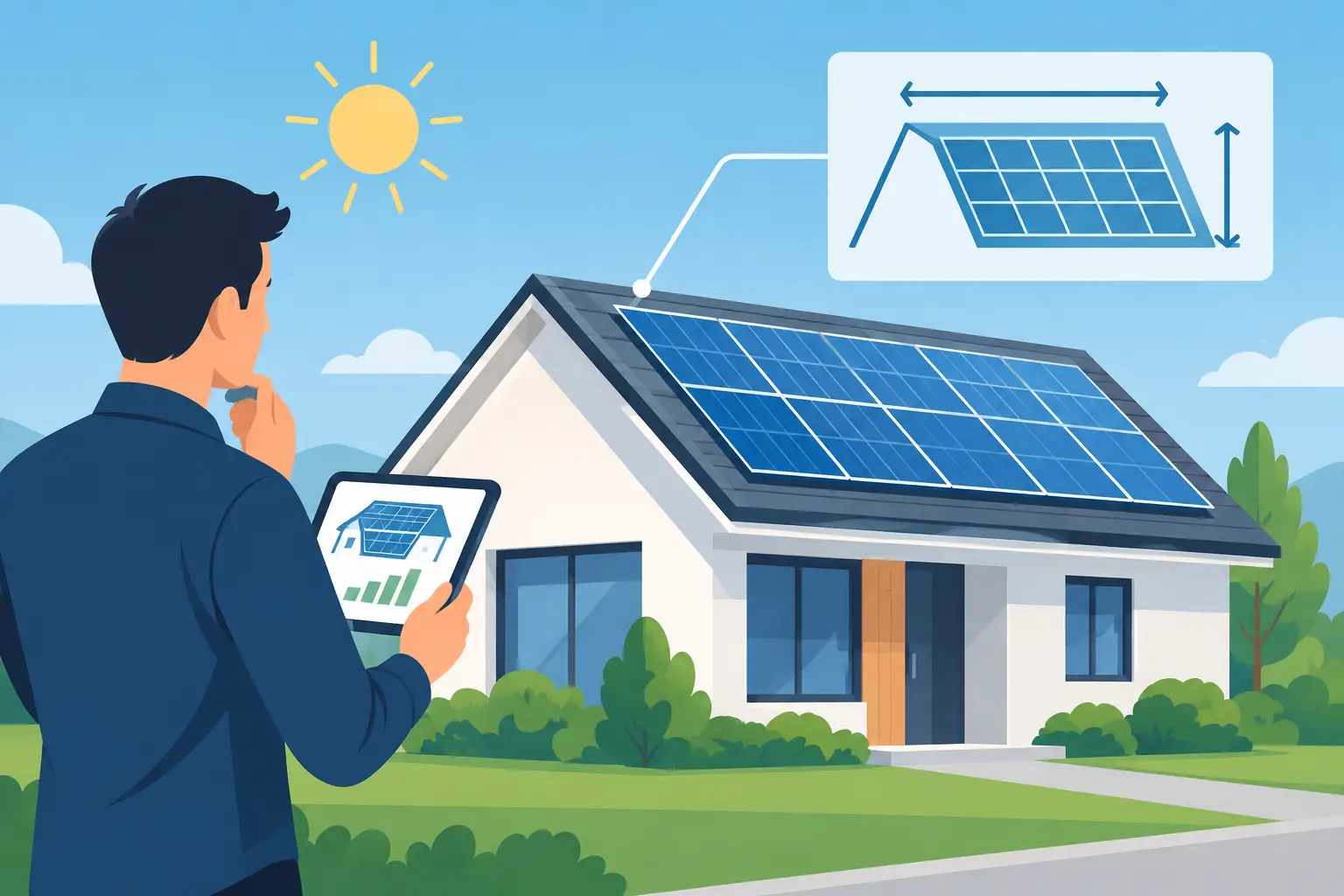
A roof does not need to face due north to be suitable for solar. North-facing panels typically produce the highest annual generation in Australia, but east and west roof sections can be highly valuable. An east-west layout spreads generation across the morning and afternoon, which may better match the usage pattern of a home or business.
Available roof space sets a practical limit, but it is not simply a matter of covering every square metre. A quality design considers shading from trees, chimneys, vents, neighbouring buildings and roof features. Even partial shade can affect output, particularly where panels share a string. Panel layout, inverter technology and electrical design should be selected to manage these site-specific conditions.
Roof orientation, pitch and structural condition also need assessment. A solar array is a long-term asset, so it makes sense to address ageing roof materials or planned renovations before installation where necessary. Relocating panels later is possible, but it adds cost and disruption.
As a general guide, modern residential panels commonly deliver around 400 to 500 watts each. A 6.6 kW system may require roughly 13 to 16 panels, depending on the panel rating and design. Larger homes, electrified households and commercial properties can require substantially more capacity. These figures are only a starting point, not a substitute for a site assessment and energy review.
Match system size to the value of solar energy
The best system size is not necessarily the one that produces the most electricity. It is the one that produces electricity with a clear purpose: reducing grid imports, charging a battery, supporting a growing electric load or earning acceptable export revenue.
When solar offsets electricity you would otherwise buy from the grid, each kilowatt-hour can avoid a relatively high retail electricity charge. When it is exported, the return is usually lower. This is why the economics of a larger system depend on your daytime consumption, retailer plan and battery strategy.
For many households, increasing daytime use is simpler and more cost-effective than installing a battery immediately. Timers and smart controls can shift suitable loads into solar hours. For others, a battery is a sensible part of the design from day one, especially where evening consumption is high, export rates are low or backup capability is a priority.
Battery capacity should be considered alongside solar array size, not separately. A large battery paired with too little solar may rely heavily on grid charging during some periods. Conversely, a very large array without enough daytime load or storage may export a considerable portion of its output. The right balance depends on consumption patterns, budget and the outcomes you value most.
Plan for electrification and future demand
A solar system should reflect where your energy use is heading, not only where it has been. Electric vehicles, reverse-cycle air conditioning, induction cooking, electric hot water and heat-pump systems can increase electricity use while reducing reliance on petrol or gas. They can also create useful opportunities to consume solar energy during the day.
If an EV charger or heat pump is likely within the next few years, include that expected consumption in the sizing discussion. It may be more economical to install sufficient panel capacity initially than to expand a system later, particularly if roof space is limited. However, future-proofing does not mean installing capacity without considering export limits, switchboard capability, inverter limits and expected financial return.
Commercial operators should also account for business growth, new machinery, extended operating hours and fleet electrification. A site that is adding cold storage, production equipment or daytime charging may justify a staged solar and battery plan. Staging can protect cash flow while ensuring the electrical infrastructure is ready for the next phase.
Understand inverter capacity and network limits
Panel capacity and inverter capacity are related but not identical. Panels are rated in kilowatts of direct current, while the inverter determines how much alternating current the system can supply to the property and grid. It is common for the panel array to be larger than the inverter rating, as panels rarely operate at their nameplate output for extended periods under real-world conditions.
The acceptable ratio depends on the equipment, site conditions and network requirements. A well-designed system can use this approach to improve generation during lower-light periods without compromising performance. The system still needs to comply with applicable Australian standards and the local distribution network’s connection requirements.
Export limits are a major consideration. Some networks restrict the amount of power a site can export, particularly in areas with high solar uptake. Export control settings, dynamic export arrangements, battery storage or greater daytime self-consumption may influence the preferred system size. A design should confirm these requirements before installation, rather than treating them as an afterthought.
For three-phase commercial and industrial connections, the design must also consider phase balancing, switchboard capacity, protection settings and the interaction with existing electrical infrastructure. This is where detailed engineering and experienced installation matter.
Factor in incentives, tariffs and ownership options
Eligible small-scale systems may receive Small-scale Technology Certificates, which can reduce the upfront cost of solar. The value available depends on factors including system size, location and installation timing. Commercial projects may have different incentive pathways and financial structures, including power purchase agreements or other funding options.
Incentives can improve affordability, but they should not drive the system size on their own. A larger system only represents good value when its generation can be used, stored or exported under favourable conditions. Your electricity retailer’s tariff structure also matters. Time-of-use pricing, controlled loads and demand charges can change the value of a kilowatt-hour saved at different times.
A careful proposal should make assumptions clear: expected annual generation, estimated self-consumption, export volume, tariff assumptions, equipment specifications and any limitations affecting performance. Solar production estimates are useful for planning, but weather, shading, energy habits and tariff changes mean actual savings will vary.
Get a tailored design before you commit
The right solar array starts with practical questions about your bills, roof, future appliances and operating hours. It then needs a design that accounts for electrical requirements, network rules and the long-term performance of the equipment. That is more useful than choosing a system size from a headline price alone.
SAE Group can assess residential, commercial and industrial energy needs and develop a solar, battery and EV charging solution aligned with the way your property actually uses power. A considered design gives you a clearer path to lower energy costs today while keeping room for the changes that may shape your energy use tomorrow.