Solar Panel Performance Review for Australian Homes
Home » Solar Panel Performance Review for Australian Homes
A solar system can look excellent on installation day and still fall short of expectations if it has not been designed for the property, energy use and local conditions. A proper solar panel performance review looks beyond the panel’s advertised wattage to assess the whole system: roof orientation, shading, inverter operation, battery strategy, consumption patterns and the support available when performance needs attention.
For Australian households, businesses and industrial sites, this matters because solar savings are not created by panels alone. They come from producing energy when it is valuable to your site, using as much of it as possible, and maintaining the system over its working life.
What a solar panel performance review should measure
Panel efficiency is often the first figure buyers compare. It describes how effectively a panel converts sunlight into electricity under standard test conditions. A higher-efficiency panel can be useful where roof space is limited, but it is not automatically the best value outcome for every project.
The more practical measure is expected annual energy yield, expressed in kilowatt-hours (kWh). This estimate should account for the system size, panel orientation and tilt, local solar resource, shading, expected losses and inverter efficiency. A 6.6 kW system will not generate the same amount in Hobart as it will in Brisbane, and two homes in the same suburb can have very different results because of roof angles, nearby trees or a neighbouring building.
For an existing system, compare generation data against the original design estimate and against seasonal patterns. Production should generally rise through longer, sunnier months and fall during winter. A sudden unexplained drop, recurring inverter faults or one panel string producing less than another may warrant investigation.
Just as importantly, review when electricity is generated and when it is consumed. A system that exports most of its production at a modest feed-in tariff may reduce bills less than a system that is carefully sized around daytime load, controlled appliances and battery storage.
Rated output is not day-to-day output
A panel’s nameplate rating, such as 440 W, is measured in laboratory conditions at a cell temperature of 25°C and a specified level of sunlight. Australian rooftops rarely operate in those exact conditions.
Heat is one of the largest variables. Panels need sunlight to generate energy, but their electrical efficiency declines as cell temperature rises. On a hot, still summer day, a dark roof can make panels substantially hotter than the air temperature. This is normal and should be reflected in a realistic production forecast rather than treated as a system fault.
Cloud cover, dust, salt exposure, shading and soiling also affect output. Light, uniform dirt may have a limited impact, while bird droppings, leaves or partial shade across a section of a panel can be more disruptive. Modern panels and inverters are designed to manage changing conditions, but system layout still matters. A quality design considers ventilation beneath panels, appropriate string configuration and the impact of shade at different times of year.
For commercial and industrial sites, review roof access and environmental exposure early. Dust from operations, coastal conditions, rooftop plant and future building works can all influence the maintenance plan and long-term yield.
Efficiency, degradation and useful life
All solar panels degrade gradually. Manufacturers commonly provide a performance warranty that specifies the minimum output expected after a set number of years, often 25 to 30 years. The warranty figure is useful, but it should be read alongside the product warranty, which covers defects in materials and workmanship.
A lower degradation rate can improve lifetime energy generation, particularly for larger commercial systems where small differences add up over decades. However, it is not the only buying criterion. The right panel selection balances output, warranty terms, supplier support, installation quality, roof constraints and budget.
It also pays to distinguish a panel warranty from a complete system outcome. The inverter, mounting hardware, isolators, cabling, monitoring platform and installation workmanship all contribute to reliability. A premium panel cannot compensate for poor design or an undersized inverter.
Review the system, not just the panels
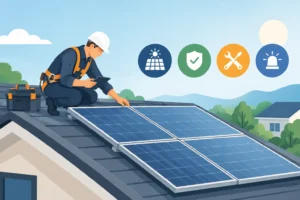
The inverter is the working centre of a solar system. It converts the direct current produced by panels into usable alternating current for the property. Its capacity, efficiency, operating voltage range and monitoring capability should align with the solar array and the site’s energy profile.
An inverter may occasionally limit output when panel generation exceeds its rated AC capacity. This is known as clipping. It is not always a problem. In some designs, modest oversizing of the panel array relative to the inverter improves generation in lower-light conditions and makes better use of the inverter across the year. The question is whether this trade-off has been modelled appropriately for the site.
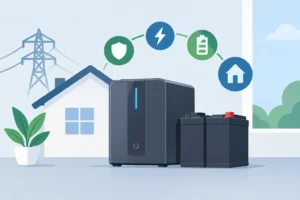
Battery storage changes the performance discussion again. A battery does not create solar energy. It stores surplus generation for later use, helping households and businesses use more of their own solar power after sunset or during higher-priced tariff periods. Its value depends on battery capacity, usable capacity, round-trip efficiency, charge and discharge limits, tariff structure and the site’s evening demand.
For a household with high afternoon air-conditioning use, additional panels may deliver stronger value than a large battery. For a business with expensive evening demand or a need for greater resilience, storage may be a better fit. There is no universal best configuration, which is why a load profile is more useful than a generic package price.
How to compare proposals fairly
A meaningful comparison starts with the expected annual generation and the assumptions behind it. Ask whether the proposal accounts for shading, orientation, inverter losses and local climate. Check whether the system is designed to reduce your own grid purchases, or whether it is simply sized to maximise installed capacity.
Look at the equipment as a connected package. Panel brand and wattage matter, but so do inverter specifications, mounting systems, monitoring, workmanship warranty and the provider’s process for service and warranty support. A lower upfront price may be attractive, yet it can become costly if the system is difficult to monitor or there is no clear aftercare pathway.
For businesses, include demand charges, operating hours and future electrification plans in the analysis. An EV fleet, new refrigeration load, electric heating or expanded production can change the ideal system size. For homes, consider planned pool pumps, reverse-cycle air conditioning, induction cooking and electric vehicle charging. Solar is a long-term asset, so design decisions should reflect where energy use is heading, not only last quarter’s bill.
Government incentives can also affect the economics. Eligible small-scale systems may access Small-scale Technology Certificates, while commercial projects can have different incentive and renewable energy certificate considerations depending on their size and structure. Feed-in tariffs vary by retailer and location, so they should be treated as one component of the financial case, not the foundation of it.
Monitoring turns performance into useful information
A monitoring app is more than a production counter. When set up correctly, it shows solar generation, grid imports, exports and, where installed, battery charging and discharging. This information helps owners shift flexible energy use into solar hours.
Running a pool pump, dishwasher, hot water system or workplace equipment during the middle of the day can increase solar self-consumption. Some loads can be automated through timers, smart controls or energy management systems. The best approach depends on the property and should not compromise comfort, operations or safety.
Monitoring also provides an early warning of underperformance. Check for production that is materially below normal seasonal levels, repeated fault messages, communication failures, unexpected grid imports during strong sunshine, or unusual differences between panel strings. Not every variation signals a fault, but prompt assessment can prevent a minor issue from becoming a long period of lost generation.
Maintenance protects long-term returns
Solar systems have no moving parts in the panel array, but they are not fit-and-forget assets. Visual inspections, electrical checks, inverter health reviews and monitoring checks are sensible ways to protect performance. The appropriate servicing interval depends on the system size, location, environmental conditions and operational requirements.
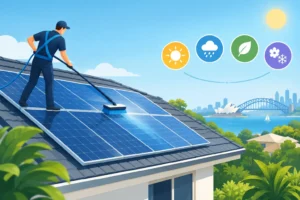
Avoid unnecessary or unsafe roof cleaning. In many locations, rain removes ordinary dust over time. Where cleaning is justified by persistent soiling, access and safety should come first. Abrasive materials, high-pressure methods and unqualified roof access can damage equipment or create risks.
For larger sites, planned maintenance is particularly valuable. It supports safety obligations, identifies issues such as deteriorating cabling or mounting concerns, and gives facility managers better confidence in the system’s expected output.
Make the review specific to your energy goals
The right result is not simply the highest generation number. It is a solar and storage solution that supports lower electricity costs, greater control over energy use and dependable performance over time. A tailored review should connect technical choices to the outcome you want, whether that is reducing household bills, improving business cash flow, supporting sustainability targets or preparing a site for electrification.
SAE Group can assess generation potential, site conditions and energy usage to help turn that goal into a practical system design, with ongoing support after installation. A well-informed decision now gives your property a better chance of delivering valuable solar energy for years to come.