Best Home Solar Batteries for Australian Homes
Home » Best Home Solar Batteries for Australian Homes
A household exporting plenty of solar power at lunchtime but buying electricity every evening has a clear battery opportunity. The best home solar batteries do more than store excess generation: they help you use more of your own energy, reduce exposure to peak electricity rates and, where configured, keep selected circuits running during a blackout.
There is no single best battery for every Australian home. The right choice depends on your electricity use after sunset, solar system size, tariff, backup expectations, existing inverter and future plans such as an EV or electric heating. A battery should be designed around the way your home actually uses energy, not selected on capacity alone.
How to choose the best home solar batteries
Start with your load profile. For many homes, the most valuable battery energy is used from late afternoon through to the following morning, when solar production has fallen and grid rates may be higher. Review interval data from your retailer or smart meter where available. It will show whether your household has a modest evening peak or sustained overnight demand from air conditioning, pool pumps, cooking and hot water.
Battery capacity is measured in kilowatt-hours (kWh). A 10 kWh battery can theoretically deliver 10 kWh of stored energy, but usable capacity may be slightly lower once operating limits are allowed for. A smaller battery can be a sensible fit for a household with low overnight use, while a larger home may need 13 kWh or more, or a modular system that can grow over time.
Power output matters just as much. Measured in kilowatts (kW), it determines how many appliances the battery can support at once. A battery with adequate capacity but limited power may cover lighting, refrigeration and electronics well, yet struggle if the oven, ducted air conditioning and pool pump run together. For blackout protection, power output and the list of backed-up circuits deserve close attention.
Round-trip efficiency is another useful comparison point. It describes how much of the energy sent into the battery is available when it is discharged. Higher efficiency generally means less solar energy is lost in storage, but it should not outweigh factors such as warranty, usable capacity, safety, installation quality and compatibility.
AC-coupled or DC-coupled?
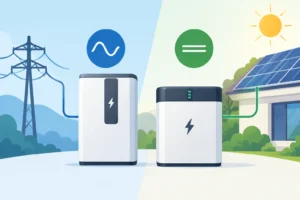
If you already have solar, an AC-coupled battery is often the practical retrofit option. It works alongside the existing solar inverter and can reduce the need to replace equipment that is still performing well. It may, however, involve additional conversion stages as power moves between AC and DC.
A DC-coupled battery can be highly efficient in a new solar and battery installation because solar energy is stored directly on the DC side before it is converted for household use. The best arrangement depends on the equipment selected, roof layout, battery location and whether your existing inverter is battery-ready. Compatibility should be confirmed before a purchase decision is made.
Battery types Australian households commonly compare
Several battery platforms regularly feature in discussions about the best home solar batteries. Their strengths are different, and availability, compatible equipment and product specifications can change.
- Tesla Powerwall 3 suits homes seeking an all-in-one battery and inverter approach, with strong power capability for many household loads. It can be appealing for new systems, although installation design and backup configuration remain critical.
- Sungrow SBR batteries are modular lithium iron phosphate systems commonly paired with compatible Sungrow hybrid inverters. Their scalable design can suit households wanting to start with a practical capacity and add storage later.
- BYD Battery-Box Premium systems are known for modularity and compatibility with selected inverter brands. They are worth considering where flexibility, staged expansion or a tailored inverter pairing is a priority.
- Enphase IQ Battery systems can be a strong option for homes using an Enphase microinverter ecosystem. Their modular architecture may suit homeowners who value component-level system design and resilience.
- Sigenergy SigenStor combines storage with an integrated energy management approach and can suit households planning for larger loads, EV charging or future expansion. As with any newer platform, local support and system design should be assessed carefully.
A brand name alone does not guarantee the right outcome. A well-matched battery with properly designed backup, compliant installation and accessible aftercare will usually deliver more value than an oversized or poorly integrated premium product.
Backup power is not automatic
One of the most common misunderstandings is that every solar battery will power the entire home during a blackout. Many systems require a dedicated backup configuration, and some are designed to support only essential circuits. Your battery may keep the fridge, lights, internet, selected power points and garage door operating, while high-draw appliances remain off.
Whole-home backup is possible in some cases, but it requires enough battery power, appropriate switchboard work and careful management of major loads. If your priority is continuity for medical equipment, refrigeration, security or working from home, identify those loads at the design stage. If the priority is running air conditioning and other large appliances during an outage, expect the required system capacity and budget to increase.
Solar behaviour during a blackout also varies by system. Some batteries can continue to use solar generation to recharge while islanded from the grid, subject to operating conditions and available sunlight. Others have more limited functionality. Ask for this to be explained clearly rather than assuming all solar production will remain available.
Cost, payback and incentives
Installed battery pricing reflects more than the battery itself. Capacity, inverter requirements, backup hardware, switchboard upgrades, site access, electrical complexity and monitoring all influence the final figure. A like-for-like quote should state usable capacity, continuous power, backup inclusions, warranty terms and any exclusions.
Battery payback depends on your solar exports, retail tariff, feed-in tariff, household consumption and the way the system is controlled. In many parts of Australia, low feed-in rates make self-consumption more valuable than exporting every spare kilowatt-hour. Time-of-use tariffs can improve the case further when a battery discharges during expensive evening periods, although tariff structures and retailer offers vary.
Government and state-based programs may also affect affordability. Eligibility rules, approved products, installation dates and funding levels can change, so incentives should be checked at the time of quoting. For some households, a virtual power plant may offer an additional revenue or bill-credit pathway, but participation can involve discharge requirements or operational controls. Read the terms and assess whether they suit your priorities.
Warranty and support deserve equal weight
A battery is a long-term energy asset, so its warranty should be considered beyond the headline number of years. Check the warranted energy throughput, retained capacity at the end of the term, labour coverage, monitoring requirements and process for making a claim. A 10-year warranty can have very different practical value depending on these conditions.
Local support also matters. The installer should be able to explain who will assist if monitoring shows a fault, an inverter needs a firmware update or a warranty claim is required. Choose an appropriately accredited installer and make sure the proposed system meets relevant Australian standards and local network requirements.
Size the battery for the home you will have
A battery can be expanded in some product ranges, but expansion is not always simple or economical. Consider planned changes over the next five to 10 years: an EV, a pool, reverse-cycle heating and cooling, induction cooking, a home office or a growing family can all alter electricity demand.
Conversely, do not oversize storage just to chase energy independence. A battery that rarely cycles because it is too large for your solar generation and household demand may take longer to justify. The goal is a balanced system that captures regular surplus solar, covers valuable consumption periods and operates within its intended duty.
The most useful next step is a tailored assessment of your bills, interval usage, roof generation and backup goals. SAE Group can design a solar and battery solution around those details, including compatible equipment, available incentives and a clear installation scope. A well-chosen battery should feel less like an add-on and more like a practical part of how your home manages energy every day.