Standalone Solar Systems for Australian Properties
Home » Standalone Solar Systems for Australian Properties
For a remote home, farm shed, pumping station or regional business, waiting for a grid connection can mean high costs, long delays and limited certainty. Standalone solar systems generate, store and manage electricity on site, giving property owners a practical alternative where connecting to the network is not viable or where genuine energy independence is required.
These systems are often called off-grid solar systems, but they are not simply a standard rooftop solar installation with a battery added later. They must be designed around how a property uses power, the local climate, future demand and the consequences of running short. Getting those details right is what turns solar equipment into a dependable power supply.
What is a standalone solar system?
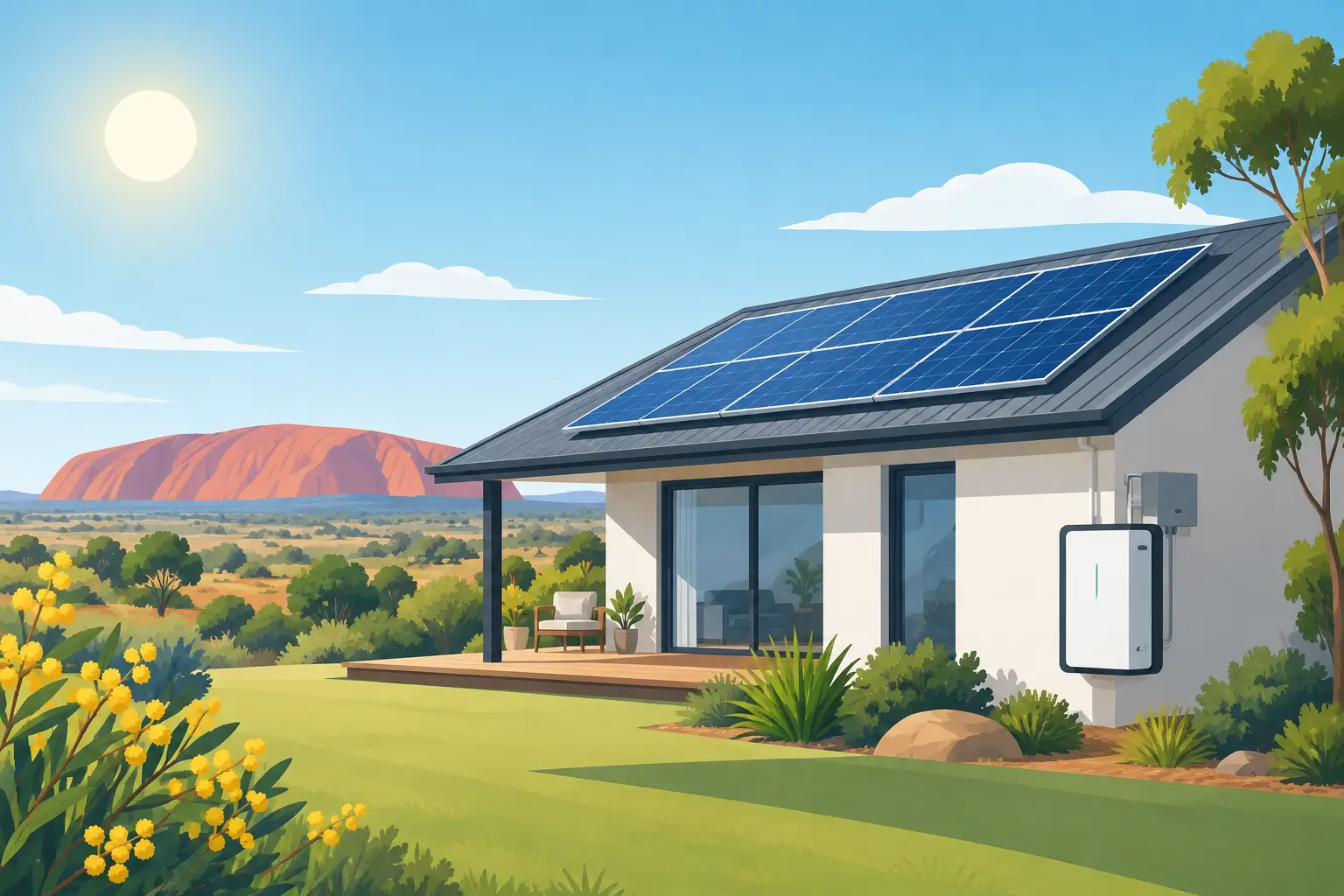
A standalone solar system operates independently from the electricity grid. Solar panels produce energy during daylight hours, a battery bank stores surplus energy, and an inverter supplies usable 240V electricity to the property. In many cases, a backup generator is included to support the system during extended cloudy weather, unusually high usage or maintenance events.
Unlike grid-connected solar, there is no network to draw from when demand exceeds solar production or batteries are depleted. The system has to meet the property’s energy needs every day of the year, including winter, wet weather and peak-use periods.
That makes design more important than panel quantity alone. A system that performs well through a bright summer day may still be undersized if it cannot carry essential loads through several low-solar days in winter.
The core components of standalone solar systems
Every off-grid project is different, yet most standalone solar systems combine four essential technologies.
Solar panels
Solar panels are the primary energy source. Their capacity is sized to cover average daily consumption while also recharging batteries after overnight use. Panel orientation, shading, roof space and local weather patterns all affect output. In remote locations, ground-mounted arrays can be a sensible option when roof angles or access are unsuitable.
Battery storage
Batteries provide electricity after sunset and when solar production is low. Battery capacity is measured in kilowatt-hours, but usable storage is only one part of the decision. The battery must also deliver enough power at any one time for loads such as pumps, refrigeration, air-conditioning, workshop tools or household appliances.
Lithium battery technology is commonly selected for its usable capacity, efficiency and cycle life. However, the right battery configuration depends on the property’s load profile, budget and required backup period.
Inverters and energy management
The inverter converts battery power into the electricity used by appliances and equipment. It also manages charging from solar, coordinates generator input where required and protects the system from faults or overloads.
For larger homes, commercial sites and agricultural operations, inverter capacity needs careful attention. A property may have modest daily energy consumption but still require high peak power to start a bore pump, cold-room compressor or machinery. Designing only around daily kilowatt-hours can leave the system unable to handle these short but critical demands.
Backup generation
A generator is not a failure of the solar system. It is a planned layer of resilience. In many standalone designs, a generator runs only occasionally, topping up batteries after prolonged poor weather or supporting exceptional loads.
The goal is to minimise generator run time and fuel use without overbuilding the solar and battery system to cover every rare weather event. The right balance depends on site access, fuel availability, business continuity needs and the cost of downtime.
Start with energy use, not equipment
The strongest standalone system design starts with an energy assessment. This means looking beyond a quarterly bill, which is unavailable for properties not yet connected to the grid and often too broad for a complex site anyway.
A detailed assessment considers what equipment runs, how long it runs, when it runs and what cannot be switched off. A household with efficient appliances and gas hot water has a very different energy profile from a rural property with electric pumping, refrigeration and a workshop. Likewise, a business that operates mainly during daylight may be able to use solar production directly, reducing battery requirements.
Future loads matter just as much. If you plan to add an EV charger, second dwelling, irrigation pump, air-conditioning, commercial equipment or expanded cold storage, allowing for that growth during design is usually more cost-effective than rebuilding an undersized system later.
Sizing for Australian conditions
Australian solar resources are excellent, but they are not identical across the country and they are not constant through the year. A standalone system must be designed for the least favourable practical conditions, not only average annual sunshine.
Winter production is often the key factor. Shorter days, lower sun angles and periods of cloud can reduce solar generation at the same time that heating, lighting and hot water demand rise. Coastal locations may face different conditions from inland sites, while shading from trees, ridgelines or nearby structures can significantly affect production.
Battery autonomy is another major choice. Autonomy refers to how long the batteries can supply essential loads without meaningful solar input. More autonomy offers greater comfort and reduced generator reliance, but it raises upfront cost. A well-designed system often combines sensible battery capacity with efficient appliances, load management and generator support for rare extended events.
This is where tailored advice has real value. There is no universally correct panel-to-battery ratio, because the right outcome depends on the property, priorities and acceptable level of generator use.
Reducing demand lowers the cost of independence
Off-grid power becomes more affordable when a property uses energy thoughtfully. Before increasing battery capacity, it is often worth addressing inefficient or high-demand appliances.
Hot water, space heating, pool pumps, electric cooking, irrigation and refrigeration can all shape system size. Timer settings can move flexible loads into the middle of the day, when solar production is strongest. Efficient pumps, LED lighting, good insulation and energy-rated appliances can reduce both daily consumption and peak demand.
For farms and businesses, operational scheduling can be especially valuable. Running pumps, processing equipment or charging tasks during solar hours may reduce pressure on battery storage. That does not mean every load must be restricted, but it does mean the system can be designed around how the site actually operates rather than an assumed worst case at every hour.
Residential, agricultural and commercial applications
Standalone solar systems are well suited to homes beyond the grid, including new builds, holiday properties and rural residences where connection costs are prohibitive. They can provide familiar household comfort when the system is matched to the way residents live.
In agriculture, they can support water pumping, livestock infrastructure, sheds, accommodation and remote monitoring equipment. A centralised system may suit some properties, while separate solar-powered solutions can be more practical for distant pumps or low-load assets.
For commercial and industrial sites, the focus is often continuity, operating costs and predictable energy supply. Workshops, tourism accommodation, remote offices, communications infrastructure and regional facilities may require a more sophisticated design with higher inverter capacity, generator integration and remote performance monitoring.
Costs, incentives and the value of proper design
Standalone solar pricing varies widely because there is no one-size-fits-all package. System cost is influenced by energy consumption, battery storage, solar array size, inverter capacity, site access, switchboard work, generator integration and installation complexity.
Eligible systems may access Small-scale Technology Certificates, commonly known as STCs, which can reduce the upfront cost of qualifying solar components. Eligibility and certificate value depend on the system and installation circumstances, so this should be confirmed as part of a formal proposal. Feed-in tariffs are generally not relevant for a fully standalone system because there is no grid connection to export electricity to.
It can be tempting to compare quotes by battery kilowatt-hours or panel wattage alone. That approach misses the value of engineering, component compatibility, protections, installation standards and ongoing support. An off-grid system is long-term infrastructure. The lowest initial price may not deliver the lowest lifetime cost if performance, service access or future expansion are compromised.
Installation and long-term support matter
A quality installation includes more than fitting panels and connecting cables. It requires site-specific design, compliant electrical work, clear commissioning and a handover that explains normal operation, monitoring and generator use.
Ongoing maintenance is usually modest, but it should not be ignored. Panels need to remain clear of excessive dirt and shade, electrical connections should be inspected at appropriate intervals, and generators require routine servicing. Monitoring can help identify changes in solar production, battery behaviour or consumption before they become a disruption.
For a property that depends on its own power supply, aftercare is as important as the installation itself. SAE Group can help assess energy needs and develop a standalone solution that accounts for daily use, seasonal conditions, site constraints and future plans.
Before selecting equipment, map the loads that matter most and decide what level of comfort and resilience the property needs. That conversation provides the foundation for a system that delivers reliable power well beyond the first sunny day.