EV Charger Guide for Australian Homes and Business
Home » EV Charger Guide for Australian Homes and Business
An electric vehicle can be one of the largest electrical loads at your property, yet many drivers begin with the cable that came in the boot and hope it will do the job. This EV charger guide helps Australian homeowners and businesses choose a safer, faster and more cost-effective charging setup – one that suits the vehicle, the site and the way energy is used.
A dedicated charger is not simply a convenience upgrade. It can help you make better use of rooftop solar, schedule charging around lower electricity rates and avoid the limitations of a standard power point. For businesses, it can also support staff charging, customer experience and the practical transition to an electric fleet.
EV charger guide: begin with your driving pattern
The right charger starts with how far the vehicle travels and when it is parked. A household EV that returns home each afternoon may only need a modest overnight charging rate. A sales team covering long distances, or a business with vehicles returning between shifts, may need higher-capacity charging and active load management.
Look at your usual daily kilometres rather than the full battery capacity alone. Most drivers do not need to charge from empty to full every night. A charger that restores your typical daily use while the car is parked is usually the sensible choice.
Also check the vehicle’s maximum AC charging rate. Installing a 22 kW charger does not mean every EV will accept 22 kW. Many models are limited to 7 kW on single-phase supply or 11 kW on three-phase supply. Matching the charger to the vehicle and available electrical supply prevents paying for capacity that cannot be used.
Portable charging versus a wall-mounted charger
A portable charging cable, often called a Mode 2 charger, plugs into a suitable power point and is useful for occasional or temporary charging. It is generally slower than a dedicated charger and should not be treated as a long-term solution where the circuit, outlet and load have not been assessed for regular high-demand use.
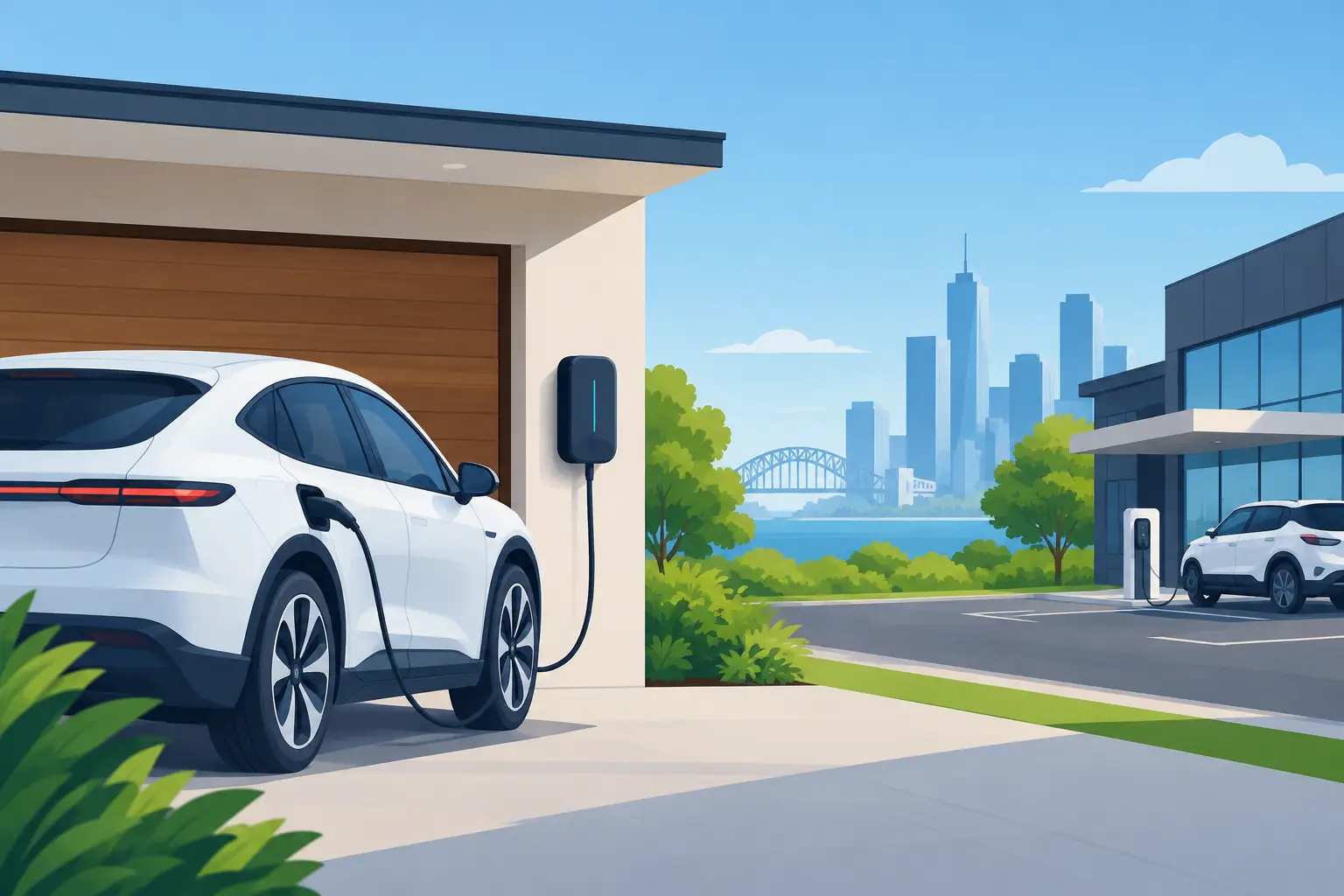
A wall-mounted Mode 3 charger is designed for routine charging. It is hard-wired or connected through an appropriate outlet, with dedicated circuit protection and professional installation. Most units allow scheduled charging, and many provide app-based monitoring of electricity use.
For regular home charging, a wall charger is usually the better long-term investment. It is quicker, safer when correctly installed and easier to integrate with solar or a battery system.
Choosing the right charging speed
In Australian homes, 7 kW is a common choice where a single-phase supply is available. It can add substantial range during an overnight charge and suits many households with one EV. A three-phase property may support 11 kW or 22 kW charging, subject to the vehicle’s capabilities, switchboard capacity and local network requirements.
Faster is not always better. Higher charging rates can increase installation costs, particularly where a switchboard upgrade, long cable run or trenching is required. They may also create higher demand at a commercial site if several vehicles charge at once.
For a business, the most practical design may be several managed 7 kW or 11 kW chargers rather than one high-output unit. This allows more vehicles to charge across the day without unnecessarily increasing peak demand. The best arrangement depends on dwell time, fleet schedules and whether chargers are intended for staff, visitors or operational vehicles.
Public DC fast chargers operate at much higher power levels and are useful for rapid top-ups on the road. They are a different category of infrastructure, typically requiring significant electrical capacity, specialised equipment and site planning. They are rarely necessary for standard home charging.
Tethered or socketed chargers
A tethered charger has a charging cable permanently attached. It is convenient because the cable is ready to use, but it should be selected with the vehicle connector and cable length in mind. A socketed charger has a Type 2 outlet, allowing drivers to use their own cable and offering flexibility where multiple vehicle types may use the charger.
For a single household vehicle, tethered can be the simplest option. For workplaces, apartments or sites where different EVs may visit, socketed charging can offer greater flexibility. Cable management matters in both cases. The cable should reach the charging port without becoming a trip hazard across a driveway, walkway or parking area.
What an EV charger installation involves
A qualified electrician should inspect the site before recommending equipment. The key question is not just whether power can reach the parking space. It is whether the existing electrical system can safely support the charger alongside air conditioning, cooking, hot water, pool equipment, solar and other major loads.
The assessment should consider switchboard capacity, available phases, cable route, protective devices, earthing and the distance between the switchboard and parking bay. Longer cable runs, difficult roof or wall access, concrete cutting and underground trenching can all affect the final installation cost.
At a home with limited supply capacity, dynamic load management can be particularly valuable. This function monitors total site demand and reduces EV charging output when other loads are high. When demand falls, the charger can increase output again. It helps protect the main supply from overload while allowing the vehicle to charge efficiently.
Commercial and industrial properties need a broader review. A site may require demand analysis, distribution board upgrades, metering considerations, parking-bay design, user access controls and future expansion planning. Installing conduit and allowing switchboard space for additional chargers at the outset can be far more affordable than reopening the site later.
Charging an EV with solar and batteries
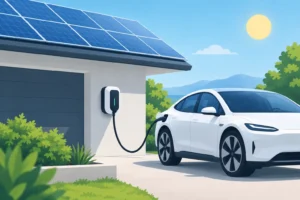
Solar can make EV ownership even more rewarding, particularly for vehicles parked at home during daylight hours or fleet vehicles that return to site between jobs. A smart charger can be configured to prioritise surplus solar generation, helping direct energy that might otherwise be exported to the grid into the vehicle battery.
There is a trade-off. Solar-only charging can vary with weather, household consumption and season. If you need the vehicle fully charged by a fixed departure time, a schedule that combines solar preference with grid charging when necessary is often more reliable.
A home battery adds another decision. Charging an EV from a battery after sunset may provide greater energy independence, but it can also use stored energy needed for evening household loads. Whether this makes financial sense depends on battery size, electricity tariffs, solar production and driving needs. A tailored system design should consider the entire energy profile, not treat the EV charger as an isolated purchase.
For businesses with solar, managed charging can avoid drawing unnecessary grid power during peak periods while making productive use of daytime generation. This is especially relevant for offices, warehouses, schools and facilities with vehicles parked during business hours.
Features worth paying for
Smart charging is one of the most useful features for most properties. It lets users schedule charging for off-peak periods, review energy consumption and, where supported, coordinate charging with solar generation. For commercial sites, it can also enable user authentication, reporting and billing for employee or visitor charging.
Consider these features when comparing chargers:
- Dynamic load management to protect available site capacity.
- Solar-aware charging to prioritise surplus generation.
- Scheduled charging for time-of-use electricity tariffs.
- Access control for shared workplace or strata parking.
- Remote monitoring and software support for fault alerts and reporting.
Do not choose on app features alone. Electrical compatibility, product warranty, local service support and the quality of the installation matter just as much. A charger is expected to operate outdoors, handle frequent connection cycles and remain part of your energy system for years.
Cost, incentives and planning ahead
EV charger pricing varies because the charger itself is only part of the project. A straightforward home installation near a modern switchboard will cost less than an installation requiring a new sub-board, long underground cabling or supply upgrades. The same principle applies to commercial sites, where civil works and electrical capacity can be significant parts of the budget.
Energy incentives and tariff arrangements change by state, retailer and network area. Rather than assuming a particular rebate applies, assess the current options for your location and compare them with the value of charging from solar or lower-cost electricity periods. The strongest savings often come from the charging strategy, not just the purchase price of the unit.
It is also wise to plan for the next vehicle. A household with one EV may soon have two. A business installing chargers for a small fleet may need additional bays as procurement changes. Selecting scalable equipment and allowing for future electrical work can protect the investment.
SAE Group can assess your charging requirements alongside solar, batteries and your wider electricity use, helping ensure the charger supports measurable long-term energy savings. The most useful next step is a site-specific conversation: where the vehicle parks, when it needs to be ready, and how your property produces and consumes power will point to the right solution.