Commercial Solar Feasibility Guide for Australian Firms
Home » Commercial Solar Feasibility Guide for Australian Firms
A commercial solar feasibility guide should start with the numbers behind your electricity use, not a panel count. For Australian businesses, the strongest projects are designed around when a site consumes energy, what it pays for power and how operational needs may change over the next decade. A system that looks large on a roof plan can still be a poor investment if most of its generation is exported at a low rate.
A proper feasibility assessment turns a broad goal – lower energy costs, greater price certainty or reduced emissions – into a practical investment decision. It identifies the suitable system size, likely savings, available incentives, site constraints and the commercial model that best suits your organisation.
What commercial solar feasibility really assesses
Commercial solar feasibility is the process of testing whether a solar power system will deliver worthwhile financial and operational value at a specific site. It goes beyond checking whether there is enough roof space. The assessment considers your interval electricity data, retail tariff, roof condition, switchboard capacity, network requirements, future load and funding options.
For a warehouse operating mainly through daylight hours, solar may offset a significant portion of grid consumption directly. A hospitality venue with strong evening trade may benefit from a different system size, battery storage or tariff strategy. Manufacturing sites can have high daytime demand but may also face complex electrical infrastructure, shift patterns and expansion plans.
The aim is not to chase the largest possible array. It is to build a system that produces electricity your business can use or store at the right times, with a clear path to savings and dependable long-term performance.
Start with your electricity data and tariff
Twelve months of electricity bills is useful, but half-hourly or interval meter data provides a much clearer picture. It shows when demand occurs across weekdays, weekends and seasons. This matters because self-consumed solar energy usually delivers more value than energy sent back to the grid.
Your feasibility assessment should examine annual consumption in kilowatt-hours, daytime baseload, peak demand charges, seasonal changes and the rates charged under your retail agreement. Demand charges can be particularly relevant for larger commercial and industrial customers. Solar may reduce purchased energy, but it will not always reduce demand charges unless the system is designed around the periods that set those charges.
Consider upcoming operational changes as well. New machinery, longer operating hours, refrigeration, additional tenancy or a growing fleet of electric vehicles can all alter the best system size. Designing only for last year’s consumption can leave a business underpowered sooner than expected.
Check the site before finalising system size
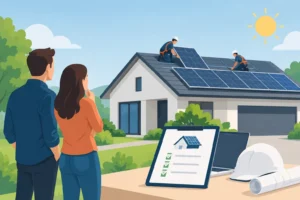
A high-quality roof is valuable, but roof area alone does not confirm solar suitability. The building needs a physical and electrical assessment before a proposal can be relied upon.
Roof orientation, pitch, shading from neighbouring structures, plant equipment and access routes affect usable space and output. North-facing panels generally offer strong annual production, while east and west orientations can be commercially valuable where a business has high morning or afternoon consumption. A mix of orientations may better match the load profile than an exclusively north-facing array.
Structural capacity is equally important. An installer should consider roof age, material, condition, load limits and any required engineering. It is often sensible to undertake roof repairs or replacement before installation rather than remove and reinstall panels a few years later.
At ground level, the assessment should cover switchboards, main cables, transformer capacity, metering and protection settings. Older electrical infrastructure can require upgrades. These costs do not rule out a project, but they must be included in the business case from the outset.
Understand network approval and export limits
Grid connection rules vary by distributor, location and system size. Your local network may approve a system with an export limit, require technical studies or set conditions for inverter controls and protection equipment.
An export limit does not necessarily make solar uneconomic. Many businesses have enough daytime use to absorb most generation on site. However, it changes the design approach. Oversizing a solar array without matching load, storage or export capacity can lead to curtailment, where production is reduced because it cannot be used or exported.
This is why feasibility should model more than total annual generation. It should estimate generation and consumption across the day, then test what happens during low-load periods such as public holidays, shutdowns or weekends.
Build the financial case around savings, not assumptions
The financial model should show expected electricity bill savings, project cost, incentives, maintenance allowances and the forecast payback period. It should also explain its assumptions clearly, including electricity price escalation, solar degradation, export value and financing costs.
For eligible systems under 100 kW, Small-scale Technology Certificates may reduce the upfront cost. Larger commercial projects may have access to a different incentive pathway, including Large-scale Generation Certificates where eligibility and accreditation requirements are met. Incentives are subject to rules and market conditions, so they should be confirmed as part of the project assessment rather than treated as a fixed figure.
A power purchase agreement can suit organisations that prefer to buy solar electricity at an agreed rate without funding the system upfront. Alternatively, an outright purchase, loan or finance arrangement may provide stronger long-term returns for businesses that want to own the asset. The right option depends on cash flow, tax considerations, appetite for capital expenditure and the length of time you expect to occupy the site.
Payback is useful, but it should not be the only measure. Look at lifetime savings, internal rate of return, cash flow from year one and the value of reduced exposure to electricity price volatility. A lower-cost system that underperforms or lacks meaningful support can become more expensive over its operating life.
When battery storage strengthens the business case
Commercial batteries are not automatically the right next step after solar. Their value depends on your load profile, tariff structure, demand charges, export restrictions and resilience requirements.
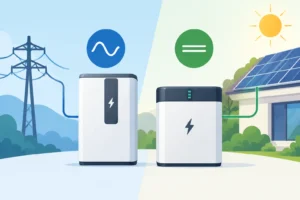
Battery storage can increase solar self-consumption by shifting excess daytime generation to the evening. It may also reduce grid demand during expensive periods, support backup power for selected critical loads and help businesses manage export-limited connections. For sites with low daytime use and high evening consumption, a battery can substantially improve the value of solar generation.
There are trade-offs. Batteries add capital cost, have a finite usable capacity and need a control strategy that reflects your tariff and operating priorities. A feasibility study should compare solar-only and solar-plus-battery scenarios rather than assume storage will deliver the best return.
Assess equipment, performance and aftercare
Commercial solar is long-term infrastructure. Panel and inverter selection should be based on reliability, warranties, suitability for the environment and expected energy yield, not simply purchase price. Coastal conditions, heat, dust, ammonia exposure, roof complexity and maintenance access can all influence equipment choices.
The proposal should set out expected annual production and identify the modelling inputs used. Actual output will vary with weather and site conditions, but transparent modelling gives your business a realistic benchmark for performance monitoring.
Maintenance planning also belongs in the feasibility stage. Larger systems benefit from regular inspections, electrical testing, monitoring and prompt fault response. Ongoing support protects system output and helps identify issues such as inverter faults, communication failures, damaged panels or unexpected shading before they have a material impact on savings.
Questions decision-makers should resolve early
Before approving a project, make sure the business can answer the following questions:
- How much daytime electricity can the site use directly?
- What export limit and connection conditions will the network apply?
- Does the roof and electrical infrastructure need work before installation?
- Which incentives or funding model apply to the proposed system?
- How will the system be monitored, maintained and supported after commissioning?
Clear answers create a more reliable investment case and reduce the risk of variations once work is underway.
A tailored assessment makes the difference
Commercial solar projects are rarely identical, even across similar buildings. Two warehouses with the same roof size can have very different outcomes because of their tariffs, operating hours, switchboards and network connection conditions. The best feasibility work brings those details together before equipment is selected.
SAE Group can assess your site, consumption profile and commercial objectives to develop a system designed for practical savings and long-term performance. Bring your recent electricity data, any future expansion plans and a clear view of your operating priorities to the conversation. That preparation helps turn solar from a broad sustainability ambition into an energy asset that works hard for your business.