Commercial PPA Explained for Australian Businesses
Home » Commercial PPA Explained for Australian Businesses
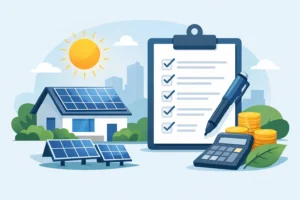
For many Australian businesses, the barrier to solar is not the value of generating cheaper power on-site. It is finding the capital upfront while protecting cash flow for stock, staff, equipment and growth. A commercial PPA explained simply is an agreement that lets a business buy solar electricity at an agreed rate, without necessarily owning the solar system from day one.
A power purchase agreement can turn an underused rooftop, car park or parcel of land into a predictable energy-cost strategy. However, the right structure depends on your site, electricity use, lease arrangements, credit position and appetite for long-term commitments. Understanding the details before signing matters just as much as understanding the headline rate.
What is a commercial PPA?
A commercial power purchase agreement, or PPA, is a contract between an electricity buyer and a solar provider or energy retailer. The provider funds, owns or manages the solar asset, and the business agrees to purchase the electricity it produces for a set period.
With an on-site commercial solar PPA, panels are installed at your premises and the energy is used directly by your operations. Rather than paying for the system upfront, you pay for the solar electricity generated and consumed, usually at a pre-agreed cents-per-kilowatt-hour rate. That rate may be fixed, increase by a stated percentage each year, or follow another agreed pricing mechanism.
The central appeal is straightforward: your business can access solar generation with little or no capital outlay, then pay for the power it uses. If that solar rate is below the cost of grid electricity, the savings can begin from the point the system is commissioned.
A PPA is not the same as buying a system outright or taking a standard equipment loan. Ownership, maintenance responsibilities, performance guarantees, insurance and end-of-term options are all defined by the agreement. These points determine whether a PPA is commercially suitable for your business.
Commercial PPA explained: how the arrangement works
The process begins with a detailed assessment of your electricity bills, interval data, operating hours, roof condition, switchboard capacity and future demand. A well-designed system should match your daytime load as closely as practical. Solar power that is used on-site generally delivers more value than exported power, particularly where feed-in rates are lower than the retail price of electricity.
Once the system size and expected production are established, the PPA provider proposes a contract term and energy rate. Terms commonly extend for 10 to 25 years, although the exact duration varies. The provider arranges the engineering, approvals, installation and, in many agreements, monitoring and maintenance.
After installation, the system generates electricity behind your meter. Your business uses that power first, reducing the volume purchased from the grid. Any remaining electricity demand is still supplied by your existing retailer. Depending on the agreement and local network requirements, excess solar generation may be exported, curtailed or credited under a separate arrangement.
Your PPA invoice is based on metered solar production or consumption, as specified in the contract. It sits alongside your usual grid electricity bill. The real comparison is therefore not whether you receive only one bill, but whether the combined cost of PPA electricity and grid electricity is lower and more predictable than continuing to rely on the grid alone.
On-site versus off-site PPAs
On-site PPAs are often the most practical option for warehouses, manufacturing sites, schools, shopping centres, farms, offices and other facilities with suitable space and consistent daytime consumption. They reduce the amount of electricity drawn through the meter at the site where it is generated.
An off-site PPA involves buying electricity, or the financial value associated with renewable generation, from a solar or wind project located elsewhere. These agreements can suit large energy users with multiple sites, limited roof space or substantial sustainability targets. They are typically more complex because they can involve wholesale energy pricing, retailer arrangements, network charges and renewable certificate considerations.
For many small to medium commercial customers, an on-site PPA is easier to assess because the connection between solar generation and avoided grid purchases is clear. Larger industrial users may find an off-site arrangement worthwhile, but usually need specialist commercial and legal review.
Why businesses choose a solar PPA
The strongest reason is usually cash flow. A business can direct capital towards its core operations while still benefiting from lower-cost solar generation. This is particularly relevant for organisations with multiple competing capital projects or a preference to preserve borrowing capacity.
A PPA can also provide a level of price certainty. Grid electricity prices can move with wholesale markets, network costs and retail contract conditions. While a PPA will not remove every energy cost, a defined solar energy rate can provide a more stable cost for the portion of demand served by the system.
There are operational benefits too. A correctly sized commercial solar system can reduce exposure to daytime grid purchases, support emissions-reduction targets and demonstrate practical action on sustainability to customers, staff, tenants and procurement partners. Where maintenance is included, the provider also carries much of the day-to-day responsibility for system performance.
That said, savings are never automatic. A business operating mostly at night, one with highly variable occupancy, or a site facing substantial roof remediation may not see the same value as a daytime-intensive facility. The proposal should be modelled against actual consumption data, not a broad estimate of what a similar business might use.
The trade-offs to assess before signing
A commercial PPA is a long-term financial commitment, so the lowest advertised solar rate should not be the only deciding factor. Read the contract alongside the system design and production forecast.
Pay close attention to these four areas:
- Pricing and escalation: Confirm the starting rate, GST treatment, annual escalations and how the rate compares with your current and expected grid costs.
- Term and exit conditions: Understand what happens if you sell the property, relocate, close the site, refinance or need to end the agreement early. Exit payments can be material.
- System performance and maintenance: Check who monitors the system, responds to faults, pays for repairs, maintains warranties and carries insurance responsibilities.
- End-of-term options: Establish whether you can buy the system, extend the agreement, have it removed or take ownership at the end of the PPA.
If you lease your premises, landlord consent and roof access rights are essential. The lease term should also be considered against the PPA term. A tenant with three years remaining on a lease may need a different arrangement from an owner-occupier planning to operate from the site for decades.
It is also worth asking how incentives are treated. Small-scale technology certificates may be relevant for eligible systems, while larger commercial projects can have different certificate and regulatory considerations. The value of any incentive, and who receives it, should be transparent in the financial proposal rather than assumed.
PPA, outright purchase or finance: which is right?
There is no single best funding model. Buying a solar system outright can deliver the strongest long-term return for businesses with available capital, because they own the asset and retain the full value of electricity savings, exports and applicable incentives. It also gives greater flexibility to add batteries, EV charging or future capacity upgrades.
Equipment finance spreads the cost while allowing the business to own the system over time. This can suit organisations that want asset ownership but prefer not to commit all capital at installation.
A PPA can be the right choice when upfront cost is the priority, when maintenance certainty is valued, or when a business prefers to pay for energy performance rather than manage a solar asset. The trade-off is that the provider retains some of the financial upside in return for funding and supporting the system.
The decision should be based on total cost over the proposed term, not just the first-year saving. Compare cash flow, expected grid-price exposure, ownership value, contract flexibility and risk allocation. A good proposal makes those differences easy to see.
Getting a commercial PPA proposal you can rely on
Before accepting a PPA, ask for a site-specific design, clear generation assumptions and a financial model based on your actual electricity profile. The proposal should show the expected proportion of solar used on-site, the assumed grid tariff, likely export volumes and the effect of any annual price escalation.
It should also account for the practical realities of your premises: roof life, structural capacity, shade, access, heritage or planning requirements, network constraints and planned changes to operations. A system designed around a business that no longer exists on paper will not deliver the outcome you expect in practice.
SAE Group helps commercial and industrial customers assess solar, battery storage and funding options around the way their sites actually operate. The most useful conversation is not simply about panel numbers or a PPA rate. It is about building an energy solution that supports lower operating costs now while remaining suitable for the business you are planning to run in five, 10 or 20 years.