Best Solar Inverter Brands for Australian Homes
Home » Best Solar Inverter Brands for Australian Homes
Your inverter is the working centre of a solar power system. Panels generate electricity, but the inverter determines how efficiently that power is converted, monitored, used in your property and, where appropriate, exported to the grid. That is why comparing the best solar inverter brands is about far more than finding the lowest upfront price.
For Australian homes, businesses and industrial sites, the right choice depends on system size, roof layout, shading, battery plans, energy-use patterns and the level of support available after installation. A well-matched inverter can help reduce reliance on grid electricity for years. A poorly matched one can limit performance, complicate future battery upgrades or create avoidable servicing costs.
What makes a solar inverter brand worth considering?
A quality inverter should be suitable for Australian conditions, compliant with local grid requirements and supported by a meaningful manufacturer warranty. It also needs to suit the way your site consumes energy. A family that uses most power after school and work has different priorities from a business with high daytime loads or a warehouse operating across extended hours.
When comparing brands, assess the inverter’s efficiency, monitoring platform, battery compatibility, warranty terms and local technical support. The best unit is not always the largest or most feature-rich model. It is the one that delivers dependable output within a system designed around your actual electricity needs.
Australian conditions also matter. High summer temperatures, salt air in coastal areas, dust, storms and changing grid requirements all place demands on solar equipment. Established brands generally offer products with proven local deployment, clear warranty pathways and installers who understand how to configure them correctly.
Best solar inverter brands for Australian properties
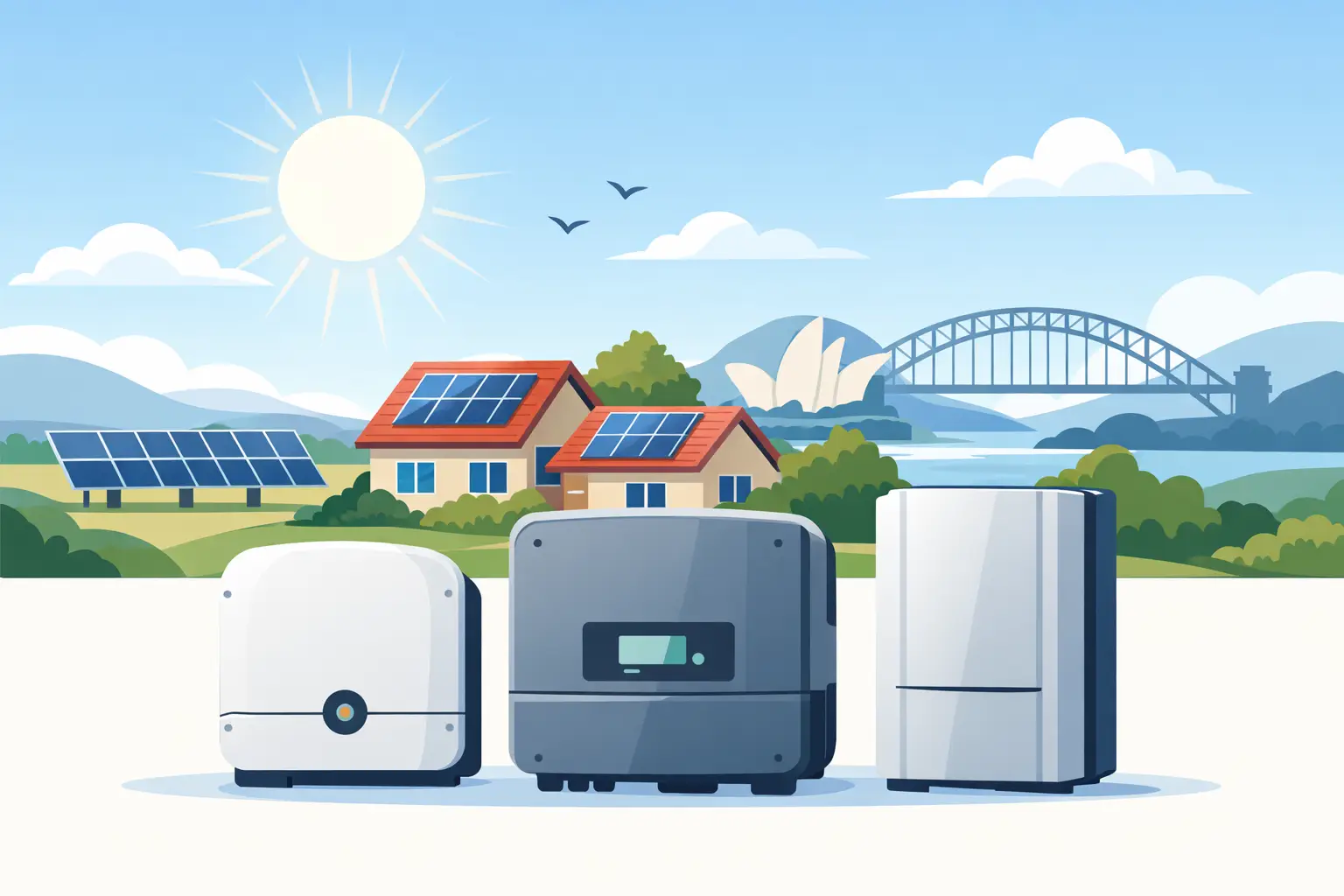
The brands below are widely recognised across the Australian market. Each has strengths that may suit different residential, commercial and industrial applications. Product availability, model specifications and compatibility can vary, so brand selection should always form part of a site-specific design.
Fronius
Fronius is a well-regarded premium inverter brand, particularly popular with homeowners and businesses that value long-term build quality, detailed monitoring and a strong service reputation. Its inverters are commonly selected for conventional grid-connected solar systems and for properties considering battery integration.
A key advantage is the depth of data available through its monitoring tools, which can help owners understand production and consumption trends. Fronius systems are often a strong fit for customers focused on system visibility and established support. The trade-off is that the upfront investment can be higher than entry-level alternatives, so it is important to weigh the additional features against expected energy savings.
Sungrow
Sungrow has become a major choice in Australia across both residential and commercial solar. Its range includes string inverters, hybrid inverters and battery solutions, making it practical for customers who want to install solar now and maintain a clear pathway to energy storage later.
For many households, Sungrow offers a compelling balance of performance, functionality and value. Commercial operators may also benefit from its scalable product range. As with any hybrid system, battery compatibility and backup capability should be confirmed at the design stage. Not every battery-ready inverter automatically provides power during a blackout without the required backup equipment and electrical configuration.
SolarEdge
SolarEdge takes a different approach by using power optimisers with panels alongside a central inverter. This can be particularly valuable on roofs affected by partial shade, multiple roof directions, chimneys or complex layouts. Rather than allowing one underperforming panel to affect a longer string, optimisation can improve the way panels operate independently.
This architecture can provide detailed panel-level monitoring and strong design flexibility. It may be a worthwhile option where roof complexity is likely to affect output. However, the system includes more equipment on the roof than a standard string inverter design, which can increase initial cost. It should be assessed against the likely production benefit, rather than assumed to be necessary for every roof.
Enphase
Enphase uses microinverters, with a small inverter installed at each solar panel. Like optimised systems, this approach can suit shaded, irregular or multi-direction roofs because each panel operates independently. It also offers detailed monitoring and allows capacity to be added more gradually in some situations.
For homeowners who place a high value on panel-level performance and modular design, Enphase can be an attractive choice. The main consideration is budget. Microinverter systems are often priced above standard string inverter systems, particularly on straightforward roofs with little to no shading. Where a roof is simple and panels can face the same direction, a quality string inverter may provide better value.
Huawei
Huawei offers smart inverter and energy storage products that have gained traction in Australian residential and commercial applications. Its hybrid solutions can appeal to customers seeking an integrated solar, battery and energy-management platform with app-based monitoring.
The brand may suit properties that want a modern, connected system and a planned transition to battery storage. As with all integrated ecosystems, it is sensible to consider product compatibility, available backup functions and the preferred long-term service pathway before committing. A system should be selected for its suitability, not simply because every component comes from one manufacturer.
String, hybrid or microinverter: which type is right?
Brand matters, but inverter type can have just as much influence on the result. Most systems use one of three approaches.
A string inverter is the common choice for uncomplicated roofs with panels installed in similar orientations. It is usually cost-effective, efficient and straightforward to maintain. For many homes and businesses, this is the practical starting point.
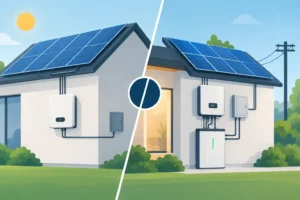
A hybrid inverter combines solar conversion with battery-ready functionality. It can be a sensible option if battery storage is planned soon, although future compatibility should be checked carefully. Battery technology, software requirements and blackout backup features are not identical across brands.
Microinverters and optimiser-based systems can be better suited to roofs with shade, varied roof faces or panels that need to be installed across different sections. They can improve design flexibility, but they are not automatically the best answer for every property. The extra equipment must deliver a measurable benefit for the additional cost.
How to compare inverter warranties and support
A warranty is valuable only when the claims process is clear and support is available when it is needed. Inverter warranties commonly range from five to 10 years as standard, with some brands offering extension options. Read the conditions rather than focusing solely on the headline duration.
Check whether labour, site attendance and replacement arrangements are included or separate. Ask who manages a fault if it occurs: the manufacturer, the installer or a third-party service provider. For commercial and industrial systems, response time and maintenance arrangements can be especially important because downtime has a direct operational cost.
Monitoring is another part of long-term support. A useful monitoring platform can identify faults, reduced production or communication issues early. However, data only delivers value when someone can interpret it and take action. Ongoing maintenance and a clear service contact can protect the investment long after the installation team leaves site.
Choose the inverter around your energy goals
The most suitable inverter begins with a clear view of how and when you use electricity. Review interval data where available, consider future appliances such as EV chargers or ducted air conditioning, and decide whether battery storage or blackout backup is a priority. A solar system designed only around roof capacity can miss meaningful opportunities to improve self-consumption and reduce bills.
For a business, include operating hours, demand profiles, refrigeration, machinery and site expansion plans. A larger inverter or a more advanced control solution may be justified where it supports daytime loads and improves the return from solar generation. For homes, the decision may be more closely tied to household routines, tariff structure and plans to add a battery.
At SAE Group, inverter selection is considered as part of the whole energy system, including solar panels, storage, monitoring, installation requirements and ongoing support. That approach helps avoid a common mistake: choosing a respected brand without confirming whether its particular model is right for the property.
A dependable inverter is a long-term energy decision, not a box to tick on a quote. Start with your power use, future plans and site conditions, then choose a proven brand and configuration that gives your solar investment room to perform.