A solar battery can turn surplus daytime generation into lower evening electricity bills, but only when it suits the way your property uses energy. Knowing how to choose solar battery storage starts with your consumption pattern, not the biggest battery advertised or a one-size-fits-all package.
For many Australian households, the strongest opportunity is simple: solar production peaks around the middle of the day, while cooking, cooling, heating and family routines push demand into the late afternoon and evening. A well-designed battery stores more of that solar energy for use when grid prices are higher. For businesses, the goal may also include reducing peak demand, managing operating costs and improving energy resilience.
Start with what you want the battery to achieve
Before comparing brands, decide which outcome matters most. A battery designed purely to increase solar self-consumption may look different from one intended to support essential appliances during a blackout. A larger system can provide more stored energy, but it may not deliver a better financial return if your solar system does not regularly produce enough excess power to charge it.
Most buyers are balancing three objectives: lower grid purchases, backup power and greater independence from changing electricity prices. The priority affects capacity, power output, inverter configuration and budget.
For example, a household that is usually empty during the day but active at night may benefit from storage that captures excess solar for evening use. A home with high daytime consumption, such as one running pool equipment, air conditioning or an EV charger, may first benefit from shifting those loads into solar hours. The battery decision should follow the load profile.
Commercial and industrial sites need the same discipline at a larger scale. Interval data can reveal whether a battery should target demand peaks, high tariff periods, solar self-consumption, backup for critical operations, or a combination of these outcomes.
How to choose solar battery capacity and power
Battery capacity is measured in kilowatt-hours (kWh). It tells you how much energy the battery can store. Power is measured in kilowatts (kW) and tells you how much electricity it can supply at one time. Both figures matter.
A 10 kWh battery may store enough energy to cover much of an average household’s evening usage, depending on its habits. But if its output is limited, it may not comfortably run several high-demand appliances at once. Conversely, a high-power battery with modest capacity can handle brief heavy loads but may not provide energy for long.
Look at your electricity bills and, where available, smart-meter interval data. Focus on the times you import the most electricity from the grid, how much solar you export, and whether your usage rises sharply in the evening. An experienced solar designer can model these patterns against your solar generation and tariff structure to estimate the most suitable size.
Usable capacity deserves close attention. Batteries are not generally designed to be drained completely every day. The usable figure is the amount available for your home or business after the manufacturer’s operating limits are applied. This is more useful than simply comparing the headline storage number.
It is also worth planning for change. An expanding family, a new EV, electric heating, induction cooking or a growing business can alter demand considerably. A modular battery system may allow you to add capacity later, although expansion rules, compatibility and installation requirements should be confirmed upfront.
Match the battery to your solar and inverter setup
A battery is part of a broader energy system. Its performance depends on the solar panels, inverter, switchboard, electrical loads and connection to the grid.
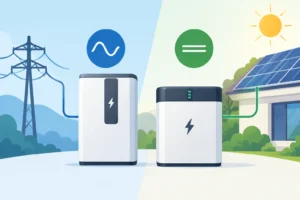
If you already have solar, the first question is whether your existing inverter can support a battery. Some systems can use a compatible DC-coupled battery, while others may be better suited to an AC-coupled battery with its own inverter. Neither approach is automatically better. The right option depends on the equipment already installed, system age, available space, budget and future plans.
If you are installing solar and storage together, an integrated design can reduce unnecessary complexity and give the system a clearer path for future expansion. It also gives your installer the opportunity to size panels, inverter capacity and battery storage as one solution rather than treating the battery as an add-on.
Ask how the system will operate when solar production is low. In winter, extended cloudy periods or high household demand, a battery may need to charge partly from the grid if your energy plan and system settings make that worthwhile. Smart controls can help prioritise solar charging, reserve backup capacity, or charge during lower-priced tariff periods where available.
Decide whether blackout backup is essential
Not every solar battery provides backup power during a grid outage. Some are installed to reduce bills only and switch off with the grid for safety reasons. If backup matters, it needs to be specified in the system design.
There is a major difference between essential-load backup and whole-home backup. Essential-load backup typically supports selected circuits, such as refrigeration, lights, internet, a few power points and perhaps a garage door. It is often the more affordable and practical option because it protects the appliances you rely on without attempting to power every load in the property.
Whole-home backup can be valuable, but it requires careful assessment. High-draw equipment such as ducted air conditioning, electric hot water, ovens, pumps and workshop machinery can exceed the battery’s output or exhaust stored energy quickly. For businesses, identify critical loads before installation: security systems, communications, refrigeration, medical equipment, servers or production controls may need a dedicated backup strategy.
Ask your installer what happens during an outage, how quickly backup activates, which circuits are covered, and whether solar can continue charging the battery while the grid is down. The answers vary by product and site design.
Compare warranties by more than years
A long warranty is reassuring, but the detail behind it is where real value sits. Compare the warranty term, guaranteed remaining capacity, throughput allowance, labour coverage and the process for making a claim.
Battery warranties commonly refer to a retained capacity after a set number of years or energy cycles. A battery that is expected to retain a defined proportion of its original capacity after ten years gives a clearer performance benchmark than a headline warranty alone. Check whether the warranty is supported locally and whether the supplier can assist with diagnostics, replacement and ongoing service.
Quality installation is equally important. Batteries need suitable clearance, ventilation where required, protection from excessive heat and weather, and a location that complies with relevant Australian standards and manufacturer requirements. A lower upfront price can lose its appeal if support is difficult to access when the system needs attention.
Consider tariffs, incentives and payback realistically
The value of a solar battery depends heavily on the difference between what you are paid for exported solar and what you pay to buy electricity back from the grid. In many cases, storing surplus solar for later use is more valuable than exporting it at a lower feed-in tariff, but the numbers should be assessed against your actual energy plan.
Government programs and state-based incentives can improve affordability, though eligibility, funding levels and requirements can change. Your assessment should account for available incentives, installation costs, expected savings, financing arrangements and the likely life of the system. Avoid promises based on a single annual saving figure without considering future tariff changes, seasonal solar production and your own habits.
For commercial customers, the financial case may include avoided peak-demand charges, operational continuity and sustainability targets as well as energy savings. A detailed load analysis is particularly valuable where tariffs are complex or energy use varies across shifts and seasons.
Choose a partner that can support the system after installation
A solar battery is a long-term asset, not a boxed appliance. Select a provider that assesses your site properly, explains the proposed design in plain language and remains available for monitoring, servicing, warranty support and future upgrades.
A useful proposal should show the recommended battery capacity and power, expected operating approach, backup scope, compatible equipment, indicative savings assumptions and any limitations. It should also make clear what is included in the installation and what may require additional electrical work.
SAE Group designs battery systems around the way Australian homes and businesses actually consume energy, with support from initial assessment through to installation and aftercare. The best next step is to review your bills, solar production and future electricity plans with a qualified energy specialist. That conversation can turn a battery from an expensive assumption into a practical investment built for the years ahead.