A solar system can have excellent panels and still underperform if its inverter is not matched to the site. Understanding inverter types helps Australian homeowners and businesses choose a system that suits their roof, electricity use, battery plans and budget – not simply the lowest upfront price.
The inverter is the working centre of a solar installation. Solar panels produce direct current (DC) electricity, while your home, business and the grid use alternating current (AC). An inverter converts that energy into usable power, monitors system performance and protects the system when grid conditions fall outside acceptable limits.
For many customers, the right choice comes down to a practical question: do you need straightforward solar savings now, or a more flexible energy system that can add battery storage and backup power later?
The main inverter types explained
String inverters
A string inverter is the most common option for Australian residential and commercial solar systems. Panels are connected in groups, known as strings, and their DC electricity is sent to one central inverter. The inverter then converts it to AC power for use on site or export to the grid.
String inverters are a strong fit for roofs with consistent sun exposure and a relatively simple layout. They are generally cost-effective, straightforward to maintain and available in a wide range of capacities. For a home with a north-facing roof free from significant shade, a quality string inverter can deliver reliable performance at an attractive installed cost.
The trade-off is that panels connected in the same string can be affected by the output of the weakest panel. Shade from a chimney, tree or neighbouring building can reduce production across that string. This does not make string systems unsuitable for shaded sites, but it does mean system design matters. Careful string layout, panel selection and shade analysis can make a material difference.
String inverters are available in single-phase and three-phase models. Most homes have single-phase power, while many larger homes, businesses and industrial sites have three-phase supply. Matching the inverter to the property’s electrical connection is essential for safe operation and compliance with local network requirements.
Hybrid inverters
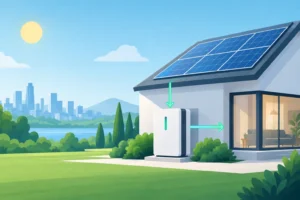
Hybrid inverters combine solar inverter functionality with battery capability. They can manage power from solar panels, the grid and a compatible battery, directing energy where it provides the best value at a given time.
During daylight hours, a hybrid inverter may run your property on solar first, charge a battery with excess generation and export remaining energy to the grid. In the evening, it can draw stored energy from the battery before importing electricity. This makes hybrid systems particularly appealing where feed-in tariffs are low compared with retail electricity rates.
For households planning to add a battery in the future, choosing a battery-ready hybrid inverter at the outset can reduce complexity later. However, compatibility is critical. Not every battery works with every hybrid inverter, and some systems have specific battery capacity, voltage or brand requirements. A future battery plan should be considered during the initial design rather than treated as an afterthought.
Backup power is another area where assumptions can cause disappointment. Some hybrid inverters support backup, but the capability may be limited to selected essential circuits such as lighting, refrigeration, internet and a few power points. Whole-home backup may require additional equipment, suitable switchboard configuration and enough battery capacity to support larger loads. Air conditioning, electric hot water, pool pumps and commercial machinery can quickly increase backup requirements.
Battery inverters for AC-coupled storage
A battery inverter is often used when storage is added to an existing solar system. Rather than replacing a functioning solar inverter, the new battery system is connected on the AC side of the property’s electrical system. This arrangement is called AC coupling.
AC-coupled batteries can be an effective option for homeowners who already have solar and want to increase self-consumption. The existing solar inverter continues converting panel output, while the battery inverter controls charging and discharging from the battery.
The main advantage is flexibility for retrofit projects. The trade-off is that electricity may be converted more than once as it moves between solar panels, battery and household loads, which can create modest efficiency losses compared with a DC-coupled arrangement. Whether that difference matters depends on the system, the household’s consumption profile and the value placed on retaining existing equipment.
Microinverters
Microinverters are small inverters installed beneath, or close to, individual solar panels. Each panel converts DC to AC independently before the electricity is combined and supplied to the property.
This approach is well suited to complex roofs where panels face different directions or experience partial shade at different times of day. Because each panel operates independently, shade or reduced output on one panel has less effect on the others. Panel-level monitoring can also make it easier to identify performance issues.
Microinverters can improve design flexibility, particularly on roofs with dormers, multiple roof planes, vents or irregular usable areas. They may also suit homeowners who expect to add a small number of panels later, subject to electrical design and network approval.
Their higher equipment and installation cost is the key consideration. There are also more electronic components on the roof, so product quality, installation standards and warranty support deserve close attention. Microinverters are not automatically better than a string inverter – they are better suited to certain site conditions.
Power optimisers
Power optimisers are sometimes discussed alongside microinverters, but they are not the same thing. An optimiser is fitted to each panel and manages DC output before sending it to a central string inverter. It can reduce the impact of mismatch between panels and provide panel-level visibility, while keeping the main DC-to-AC conversion in one inverter.
For a roof with intermittent shade or multiple orientations, optimisers may offer a useful middle ground between a standard string inverter and a full microinverter system. As with any additional component, the value should be assessed against the expected energy gain, system complexity and long-term support arrangements.
Choosing between inverter types
The most suitable inverter is determined by the entire energy system, not by one specification on a brochure. A well-designed proposal should consider your roof layout, shading, electricity consumption, switchboard, phase connection, local distributor rules and plans for future electrification.
For a typical home with an uncomplicated roof and no immediate battery plans, a quality string inverter is often the most economical route to lower daytime electricity bills. A hybrid inverter may be more appropriate when battery storage, time-of-use energy management or backup power is part of the plan. Microinverters or optimisers can be worthwhile where shading and roof complexity would otherwise reduce output.
Commercial and industrial projects require an additional layer of assessment. Demand profiles, large motors, refrigeration, operating hours, export limits and peak-demand charges can all influence inverter sizing and configuration. A business that consumes most electricity during the day may prioritise solar generation capacity, while an operation with evening loads may see greater value in battery integration and energy management controls.
It is also worth separating inverter size from solar panel capacity. A 10 kW solar array does not always require a 10 kW inverter. In some circumstances, designers deliberately install more panel capacity than inverter capacity, known as DC oversizing. Because panels rarely operate at their nameplate maximum for long periods, this can improve generation in lower-light conditions. The appropriate ratio depends on the equipment, roof orientation, network rules and expected load profile.
Questions to ask before selecting an inverter
Before approving a solar quote, ask whether the inverter is compatible with a future battery, what backup power will actually operate during an outage, and how the system will perform if part of the roof is shaded. You should also confirm the warranty terms, monitoring access, service process and whether the inverter suits your single-phase or three-phase supply.
For business and industrial sites, ask how the proposed design addresses demand charges, export constraints and operational continuity. The lowest-cost inverter may not deliver the lowest lifetime energy cost if it limits expansion, lacks the required monitoring or does not suit the way the site consumes power.
A reputable provider should explain these choices in plain language and design around your energy objectives. SAE Group assesses solar, battery and inverter options as part of a broader energy solution, helping customers balance upfront investment with long-term performance and support.
The best inverter is rarely the one with the longest feature list. It is the one that fits your roof, your electricity habits and the energy decisions you expect to make over the next decade.