Battery Generator Comparison for Australian Homes
Home » Battery Generator Comparison for Australian Homes
A blackout is when the differences between power options become very real. The fridge, internet, medical equipment, workshop tools or business systems do not need a marketing claim – they need dependable electricity. This battery generator comparison separates three commonly confused products: portable battery generators, home solar batteries and conventional fuel generators.
They can all provide backup power, but they suit very different loads, budgets and operating needs. Choosing well starts with understanding how long you need power, what must stay running, and whether your goal is occasional emergency use or lower electricity costs every day.
Battery generator comparison: the three main options
The term “battery generator” is widely used for a portable power station. It is not technically a generator because it does not create electricity from fuel. Instead, it stores electricity in a battery and supplies it through AC outlets, USB ports or DC connections. Most can be recharged from a wall outlet, a vehicle or compatible solar panels.
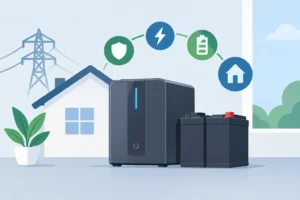
A home battery system is a larger, permanently installed battery connected to the property’s solar inverter or a dedicated hybrid inverter. It stores excess solar energy for use after sunset, during expensive tariff periods and, when designed for it, during a grid outage.
A petrol, diesel or LPG generator produces power while it has fuel. It is often the practical choice for high-demand, temporary or remote applications, particularly where long run times matter more than quiet operation or emissions.
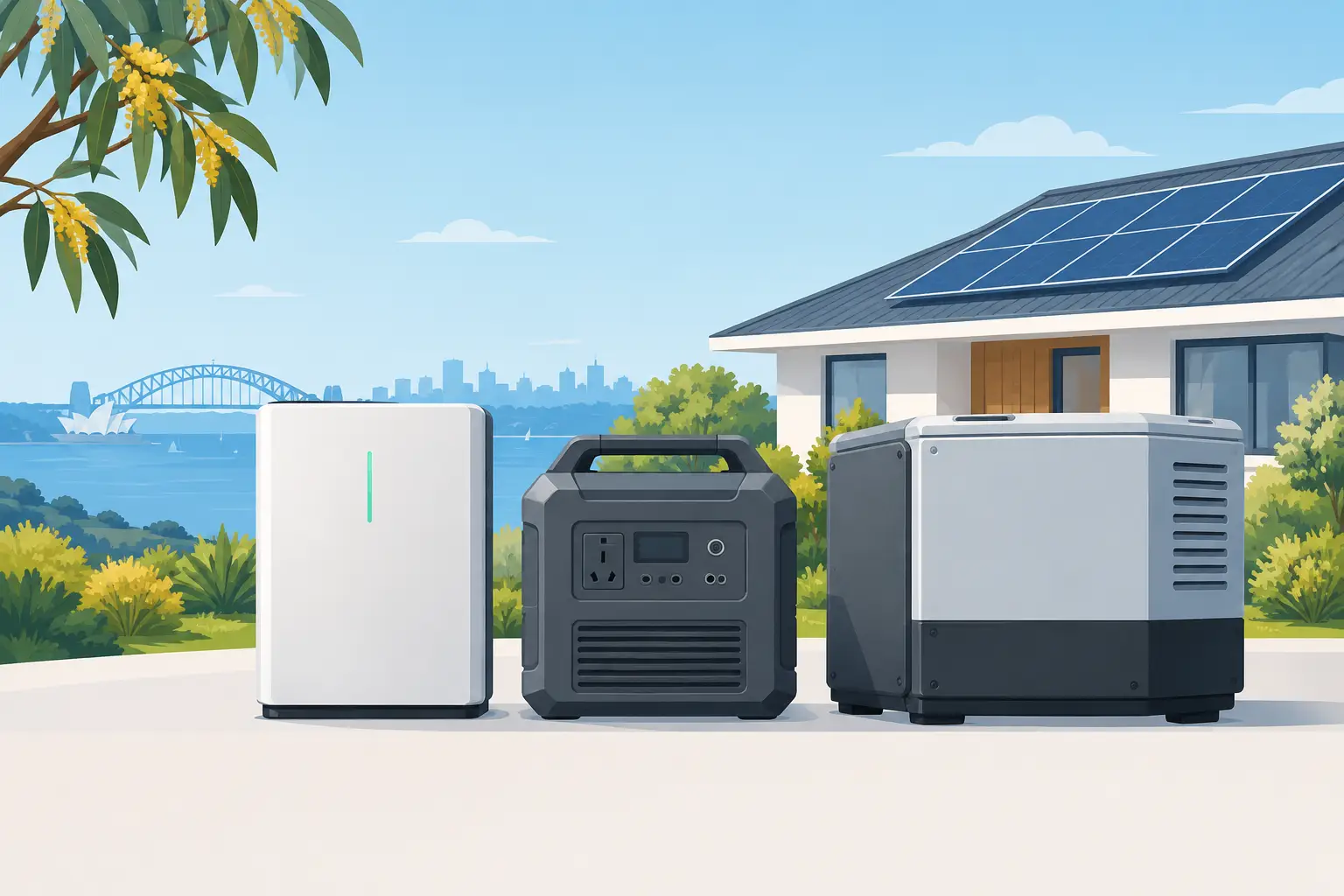
| Option | Best suited to | Key strength | Main limitation | |—|—|—|—| | Portable battery generator | Camping, small backup loads, short outages | Quiet, emissions-free at point of use and easy to move | Limited capacity and output | | Home solar battery | Homes and businesses seeking daily savings and backup | Uses stored solar energy and can reduce grid reliance | Requires professional design and installation | | Fuel generator | Remote sites, long outages and high-starting loads | Can run for extended periods with available fuel | Noise, fuel costs, maintenance and exhaust emissions |
Start with the loads, not the product label
The right system is determined by what you need to power. A portable battery generator may comfortably run mobiles, laptops, lights, a modem and a small fridge. It may not run an electric hot-water system, ducted air conditioning, an induction cooktop or several appliances at once.
For a home, identify essential circuits before comparing battery sizes. Common priorities include refrigeration, lighting, internet, selected power points, a garage door, security systems and certain medical devices. A well-designed backup setup may also support a pool pump, air conditioning or cooking appliances, but those loads require higher inverter capacity and more stored energy.
Commercial and industrial sites need an even more detailed assessment. A small office may only need communications, lighting and critical IT equipment. A workshop, farm, cold-storage facility or production site may have motors, pumps, compressors and machinery with substantial starting currents. Battery capacity matters, but inverter output and load management are equally important.
Capacity and power are not the same thing
Battery comparisons can become confusing because two ratings are often presented together. Capacity, measured in kilowatt-hours (kWh), indicates how much energy a battery can store. Power, measured in kilowatts (kW), indicates how much electricity it can deliver at one time.
Think of capacity as the size of the fuel tank and power as the size of the engine. A 10 kWh battery may have enough stored energy for essential household loads over many hours, but it still needs sufficient output to start and run those loads simultaneously.
A portable unit rated at 1 kWh may be useful for communications and small appliances, yet be unable to support a kettle, microwave and heater together. Likewise, a home battery with strong capacity but modest power output may need a carefully selected backup circuit to avoid overloads.
When comparing equipment, ask for both the continuous power rating and surge capability. Motors and compressors can draw a brief but significant burst of power when starting. This detail is particularly relevant for refrigerators, pumps, cool rooms and workshop equipment.
Runtime depends on how electricity is used
No battery generator comparison is complete without looking at runtime realistically. A battery does not deliver its headline capacity entirely to connected appliances. Some energy is lost through conversion, and real consumption changes as appliances cycle on and off.
A modem and several LED lights use relatively little energy. A portable heater, electric oven or reverse-cycle air conditioner can use much more. During an outage, sensible load management can dramatically extend backup time. Running only essential circuits is often more valuable than purchasing a system that attempts to supply every appliance as though the grid were still available.
Solar charging changes the picture. A home battery paired with suitably sized solar can recharge during daylight, allowing the property to use solar production directly and preserve stored energy for the evening. However, solar output varies with weather, season, roof orientation and shading. It should be modelled as part of the full system, not treated as a guaranteed refill.
Fuel generators can continue operating as long as fuel is available, but this creates another planning requirement. Fuel must be stored safely, kept fresh where relevant, and available during wider disruptions. A generator also needs refuelling, ventilation and regular maintenance.
Backup power versus bill savings
A portable power station is usually purchased for convenience and resilience. It can be a useful addition for travel, a ute, a caravan, occasional work away from mains power or short household outages. It generally will not make a meaningful difference to everyday electricity bills unless it is regularly charged from surplus solar and used strategically.
A home battery is designed to deliver value every day. It stores solar energy that might otherwise be exported to the grid at a lower feed-in tariff, then supplies that energy later when household or business demand is higher. Its financial return depends on your consumption profile, solar production, tariff structure, export rate, battery size and future electricity prices.
For businesses, batteries can also reduce demand during expensive periods, improve the use of on-site solar and support operational continuity. The strongest case is not always the biggest battery. It is the system sized around the site’s load profile, operating hours and commercial objectives.
Noise, emissions and placement matter
Battery systems operate quietly and have no exhaust emissions at the point of use. This makes them well suited to residential areas, indoor-adjacent installations and businesses where noise or fumes would disrupt staff, customers or neighbours.
Fuel generators need an outdoor location with appropriate ventilation and safe separation from doors, windows and air intakes. They can be loud, and exhaust fumes can be hazardous. Never operate a fuel generator in a garage, shed or enclosed space, even if doors are open.
Permanent home batteries also have installation requirements. Placement, clearances, temperature exposure, switchboard condition, solar configuration and backup requirements should be assessed by qualified professionals. The cheapest equipment is not necessarily the lowest-cost outcome if it cannot be integrated safely or supported over its service life.
What to compare before you buy
Price matters, but it should sit alongside performance, safety and support. For a portable unit, compare usable capacity, AC output, recharge time, solar input limits, warranty, outlet types and portability. Consider whether it can run your actual appliances, not simply whether it has enough ports.
For a home or business battery, compare usable kWh, continuous and peak output, scalability, warranty terms, inverter compatibility, backup functionality and monitoring. Also confirm what happens during a blackout. Some systems can power selected circuits only, while others can support broader backup when appropriately designed.
Aftercare deserves close attention. Batteries and inverters are long-term energy assets, not one-off retail purchases. Professional system design, compliant installation, warranty support, monitoring and maintenance help protect performance well beyond installation day.
Choosing the practical option for your site
Choose a portable battery generator when you need quiet, mobile power for light loads and short-duration backup. Choose a fuel generator when you need extended runtime, high power or remote operation and can manage fuel, noise and maintenance. Choose a professionally designed solar battery when you want to reduce ongoing electricity costs, use more of your own solar energy and improve resilience at home or across a business site.
For many Australian properties, the best answer is not an either-or decision. A solar battery can manage daily energy use and essential backup, while a portable unit supports travel or small mobile loads. In remote or critical operations, a generator may remain a sensible contingency alongside solar and battery storage.
A tailored assessment turns the comparison into a practical energy plan. By matching your essential loads, solar production, tariff and backup expectations to the right equipment, you can invest in power that supports your property when it matters most.