How to Maintain Solar Batteries for Longer Life
Home » How to Maintain Solar Batteries for Longer Life
A solar battery should quietly reduce your reliance on the grid, store surplus daytime generation and provide useful backup when it is configured to do so. When performance drops or an alert appears in the monitoring app, however, the battery becomes impossible to ignore. Knowing how to maintain solar batteries helps Australian households and businesses protect a significant energy investment, avoid preventable faults and keep savings on track.
For most modern lithium battery systems, maintenance is less about hands-on work and more about monitoring, correct operating conditions and qualified support. The goal is not to constantly adjust the system. It is to spot changes early and ensure the battery, inverter and solar panels are working together as designed.
What battery maintenance really involves
Solar batteries are not all maintained in the same way. Most new residential and commercial systems use lithium-ion chemistry, commonly lithium iron phosphate. These batteries are sealed, electronically managed and designed for low routine maintenance. Owners should not open the casing, touch internal wiring or attempt repairs themselves.
Older lead-acid batteries require more direct attention. Depending on the model, this can include checking electrolyte levels, terminal condition and ventilation. They also have different charging requirements and are more sensitive to deep discharge. If you have a lead-acid system, use its manufacturer instructions and arrange servicing with a qualified technician rather than treating it like a lithium battery.
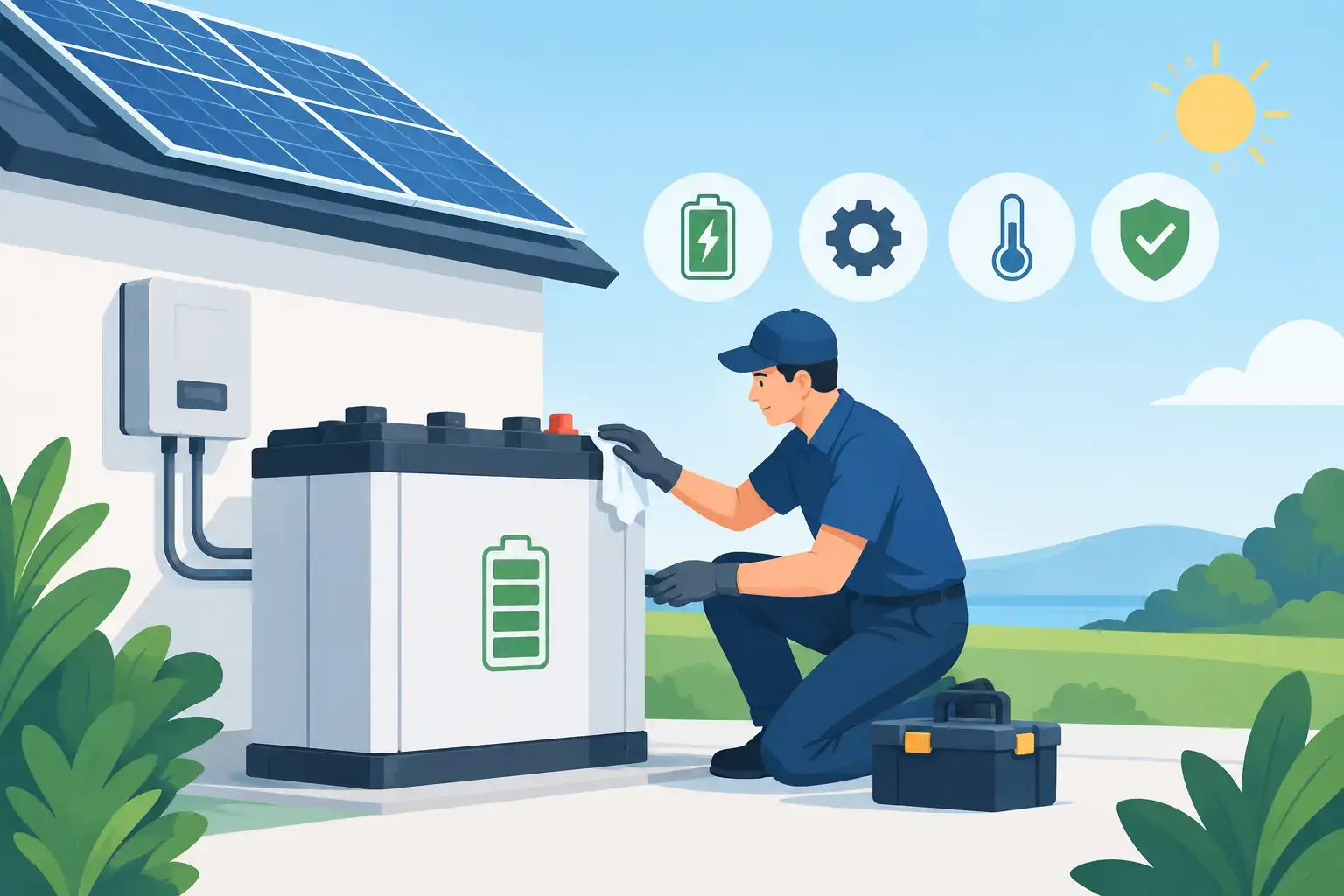
For lithium systems, a practical maintenance plan usually covers the monitoring platform, the battery’s physical environment, inverter performance, electrical connections and software updates. It also confirms that the system settings still suit how the property uses energy.
How to maintain solar batteries through monitoring
Your monitoring app is often the first place a performance issue will appear. Check it regularly enough to understand what normal operation looks like for your system. For a home, a monthly review is generally useful. For a business with higher energy use or critical loads, more frequent checks may be warranted.
Look beyond the battery percentage. Review how much solar generation is charging the battery, when the battery discharges, whether grid imports have changed and whether fault notifications are appearing. A battery sitting at a low state of charge is not necessarily a problem during poor weather or a high-demand period. A repeated pattern of poor charging on bright days, however, deserves investigation.
Many systems also allow owners to select operating modes. You may prioritise self-consumption to reduce evening grid usage, retain a reserve for outages, or schedule charging from the grid where an electricity plan makes this worthwhile. These settings affect bill savings and battery cycling, so revisit them when your tariff, household routines or business operating hours change.
Do not ignore a warning simply because the battery still appears to work. Communication errors between the inverter and battery, unusual temperature alerts or repeated shutdown messages can become larger problems if left unresolved.
Keep the battery in the right environment
Australian conditions can be demanding. Heat is one of the main factors that can affect battery performance and long-term life, particularly in garages, sheds, plant rooms and external walls exposed to afternoon sun. A correctly designed installation will account for the manufacturer’s temperature limits, ventilation requirements and clearance rules, but the surrounding area can change over time.
Keep the battery location clean, dry and free from stored items. Do not stack boxes, gardening equipment, paint tins or household rubbish around the enclosure. Clear access makes inspections safer and allows heat to dissipate as intended. It also gives technicians room to work if a service call is needed.
Avoid directing sprinklers at an external battery system, and check that nearby drains, gutters and downpipes are not creating water exposure. If the battery is installed in a garage, take care not to knock it with a vehicle, bike or lawn equipment. Physical damage to an enclosure should be assessed promptly, even if there is no visible performance issue.
For commercial and industrial systems, site conditions deserve additional attention. Dust, salt air, pests, vibration, plant-room temperatures and access control can all affect equipment reliability. Maintenance plans for larger battery energy storage systems should be aligned with site safety procedures and operational risk requirements.
Protect battery life without overthinking it
Every battery gradually loses usable capacity over time. This is expected, not proof that the system has failed. Battery warranties commonly set performance conditions over a stated number of years, energy throughput or cycle count. The best approach is to use the battery for the purpose it was designed for while avoiding unnecessary stress.
That means allowing the battery management system to do its job. Modern batteries include built-in protections that manage charge rates, operating temperatures and usable depth of discharge. Trying to force the battery to stay at 100 per cent all day, or manually switching modes in response to every weather forecast, is rarely beneficial.
There are still sensible choices that can reduce avoidable wear. If backup power matters, set a reserve level that covers your essential loads rather than keeping the entire battery unavailable for daily bill savings. If your electricity retailer offers time-based pricing, assess whether scheduled charging and discharging will deliver genuine value after allowing for battery wear and energy losses. The right answer depends on your tariff, solar production, load profile and backup priorities.
High-demand appliances also influence outcomes. A battery may not be sized to run ducted air conditioning, electric heating, pool pumps, workshop equipment and cooking appliances simultaneously through an outage. Understanding the limits of your backup circuit prevents overloads and helps set realistic expectations.
Arrange professional system checks
Even low-maintenance batteries benefit from professional inspection. A qualified solar and battery technician can check connections, cabling, isolators, inverter operation, fault history, firmware status and charging behaviour. They can also identify issues elsewhere in the system that affect battery performance, such as reduced solar output, inverter faults or network configuration changes.
For many residential systems, an annual review is a sensible benchmark, particularly once the system is out of its initial installation period or if it operates in harsh conditions. Commercial and industrial systems may need planned inspections at intervals based on system size, operating duty, manufacturer requirements and site obligations.
A service visit is also a good time to discuss whether your system is still matched to your needs. A household may add an EV charger, work from home more often or replace gas appliances with electric alternatives. A business may extend trading hours, install new machinery or take on more temperature-controlled stock. These changes can shift when and how energy is consumed, making battery settings or capacity worth reviewing.
SAE Group can support this process with system servicing and maintenance designed around the equipment, energy goals and operating environment of the site.
Know when to call for support
Some signs call for a prompt professional assessment rather than routine observation. These include visible damage, burning smells, liquid leakage, swelling, corrosion, repeated error messages, unexpected shutdowns or a sudden and sustained change in available capacity. Keep people away from damaged equipment and follow the shutdown or emergency instructions supplied for your system.
You should also seek advice if the battery has been exposed to flooding, significant impact, fire nearby or extreme heat beyond its specified operating range. Do not restart, reset or dismantle equipment if you are unsure of its condition.
Keep installation documents, warranty details, commissioning records and monitoring account access in a safe place. They make it easier to diagnose faults, lodge warranty support requests and confirm what equipment is installed at the property. If you sell the property or change facility managers, ensure the system documentation and monitoring access are transferred properly.
Make maintenance part of your energy plan
The best battery maintenance is proactive but uncomplicated: keep the installation area clear, check system data, respond to alerts and use qualified technicians for electrical and warranty-related work. That routine helps protect performance while letting the system do what it was installed to do – turn more of your solar generation into practical savings and greater energy confidence.