
Your place. Your power.
Off-grid solar and battery solutions.
Generate, store and manage energy where you live and work. SAE Group designs off-grid solutions around your property, your daily needs and the conditions your system needs to handle.
Australian owned · Designing energy solutions since 2010
What is an off-grid solar system?
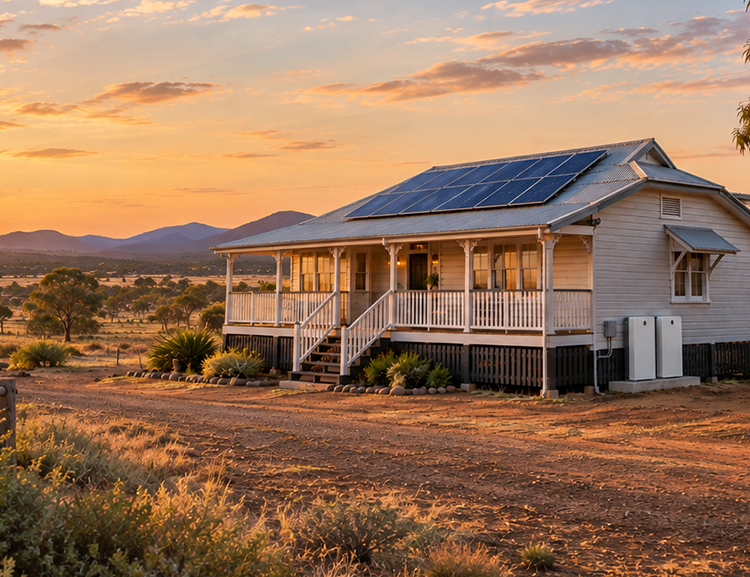
An off-grid solar system is a standalone power system that operates independently of the electricity network. It uses solar panels, battery storage and suitable inverters and controls, often with a backup generator. SAE Group designs systems around Australian rural homes, farms and remote businesses.
We help you understand the options and trade-offs, including seasonal conditions, running costs and ongoing care, before you commit.
Your independent energy system
A simplified view. Your system and backup strategy are designed around your property and energy needs.
Rural and remote homes
Plan power for everyday living, from refrigeration and lighting to hot water and air conditioning, with the loads assessed together.
Farms and acreage
Consider the needs of your home, sheds, pumps and equipment, including high starting loads and seasonal changes in demand.
Remote businesses
Explore an independent energy supply designed around your operating hours, critical equipment and future plans.
Designed around your needs
One system. Every part working together.
Solar generation
Panels sized and positioned around your location, available space and expected seasonal energy production.
Battery storage
Storage planned around evening use, essential loads and the period of autonomy you need when solar production is low.
Inverters and controls
Equipment selected to manage power flow and support the loads you intend to run, including starting demand where relevant.
Backup generation
Generator support considered for extended low-sunlight periods or high demand, with fuel, servicing and operating requirements explained.
Monitoring and operation
A clear view of your system and practical guidance on energy use, with monitoring options suited to the equipment and connectivity available.
Ongoing support
Servicing, maintenance and upgrade options to support your system as your property and energy needs change.
The details make the difference
Built for more than a sunny day.
A useful off-grid design looks beyond average daily consumption. We assess when you use energy, what needs to run together and how your system should respond when conditions change.
- Daily energy use, peak power demand and the starting loads of pumps or motors.
- Winter conditions, shade and periods of low solar generation.
- Battery autonomy, essential loads and a suitable backup strategy.
- Future appliances, equipment or buildings that could change your needs.
A clear path to independent energy.
01
Tell us about your property
Share the location, what you need to power, any existing equipment and whether a grid connection is available.
02
Assess your energy needs
We review usage, major appliances, site conditions and the level of autonomy you want.
03
Review your proposal
Compare a tailored system design with clear equipment choices, costs and operating expectations.
04
Install and hand over
Your system is installed and commissioned, with guidance on controls, energy management and routine care.
05
Keep your system supported
Discuss servicing, monitoring and upgrades as the way you use the property changes.
Your questions answered
A few things worth knowing.
Is an off-grid system the same as solar with a battery?
No. A typical grid-connected solar and battery system still relies on the electricity network. An off-grid system is designed to operate independently and needs suitable equipment, capacity, controls and a backup strategy.
Will I need a generator?
Many off-grid designs include a generator for extended periods of low sunlight or unusually high demand. Whether one is needed, and how often it may run, depends on your location, loads, solar and battery sizing, and the level of reliability you need.
Can an off-grid system run pumps, air conditioning or workshop equipment?
It may be possible, but the system must be designed for the equipment’s running and starting loads. Tell us which appliances and machines need to run together so we can assess the requirements.
Can I use my existing solar panels or battery?
Possibly, subject to an assessment of compatibility, capacity and condition. Not every grid-connected inverter or battery can operate as part of an off-grid system.
Should I disconnect from the grid if it is already available?
It is worth comparing a fully off-grid design with a grid-connected solar and battery solution. We can discuss the installation costs, operating needs, backup arrangements and practical trade-offs for your property.
What does an off-grid system cost?
The cost depends on your energy demand, location, required autonomy, equipment, installation conditions and backup generation. A tailored assessment gives a more useful answer than a standard package price.
Compare your energy options.
Solar for your home
If a grid connection is available, compare a residential solar system with your off-grid options.
Home battery storage
Understand how a battery can increase self-consumption while remaining connected to the grid.
Energy for your business
For a connected business site, explore commercial solar, storage and electrical infrastructure.
Tell us where you want to take your energy.
From a new rural home to a working property, we will help you explore an off-grid solution around your needs.
Useful details for your enquiry: property address, grid availability, major appliances or equipment, and any existing system.